Sunday, February 24, 2008

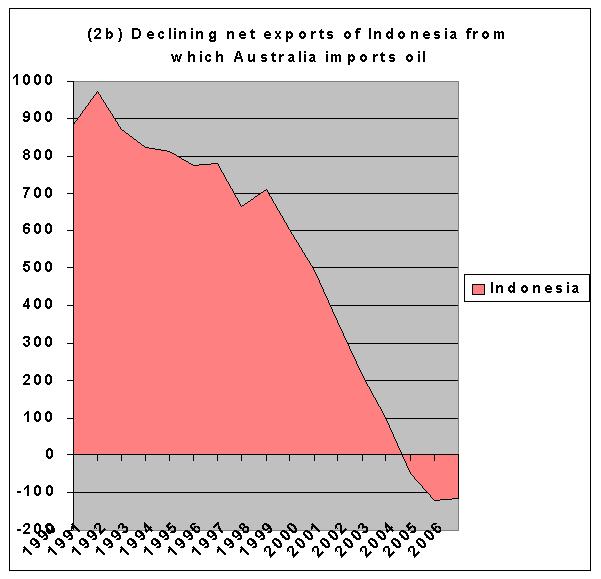
Like the US, other oil producing countries are finding their own needs are reducing their ability to export oil

Case in point: Indonesia

The Oil Drum:

TOD has featured the Export Land Model (ELM) on several occasions (http://www.theoildrum.com/node/3018 ). A summary can also be found in Wikipedia.

The concept is deceptively simple:
Oil producing countries service internal markets first, and then export their surplus. Observations of oil exporting countries show that their internal markets continue to grow rapidly even after the peak. So their exports are hit by 2 factors - declining production and increasing domestic consumption. As a result, their export capacity drops with unexpected rapidity.

Labels: , ,

Friday, November 02, 2007

A Slight Hitch in the Cheap Chinese Goods Game

Price controls on fuel have affected supplies

english.aljazeera.net:


Oiling China's wheels

China's growing economic might is fuelling massive demand for foreign oil, but record crude prices are proving a major burden for both the government and consumers.

In the latest in an Al Jazeera series on China, Melissa Chan reports from Beijing on the challenges soaring prices and rising demands pose.

China's transport network is crucial in keeping the country's economy rolling along.

Trucks take products from the factories to the ports, from where they sail to the rest of the world.

But there is a problem that is slowing down this process so imperative in keeping China's economy going - the higher cost of fuel.

China faces an international high price on crude oil, but officials keep petrol prices artificially low.

That creates its own set of problems, which have the potential to affect the flow of traffic and therefore the flow of commerce.

Price controls

Oil refineries do not have much incentive to produce fuel if the profit margin is low or if it would bring them losses.

So they have stopped producing diesel, and China's trucks now wait in long lines at filling stations.

"The same route that took me two days, now takes five. I can't find enough diesel," one driver says.

"It's my company's truck, so I don't know the details. But, of course there has been an effect on our business," another says.

The lack of diesel means that goods manufactured for the foreign market are taking longer to hit the shelves.

Truck drivers have to wait in long queues
for diesel as supplies have dried up


China needs to take a closer look at its price control policy on fuel, walking a fine line between international market pressures and keeping its people happy.

"For price reform one major rule is to give the international market rate a quick response. Now, for import oil, it accounts for 50 per cent of the market," Yang Fuqiang from the Energy Foundation says.

"Before, it was a small portion, so the Chinese central decision makers did not pay attention to the international oil market. Now they have to."

What is happening in China is likely to have a noticeable effect on the movement of manufactured goods.

Which means that this Chinese issue is something everyone should keep an eye on.

Labels: , , ,

Friday, September 28, 2007

Imagine how this chart will look if the US invades Iran


We have is a confluence of two potentially synergistic and mutually disastrous events.

Here's one:

Energy Bulletin, October 30, 2004:
Demographic Trends

It's a purely connect-the-dots exercise, though demographic trends here in Asia could have a bigger influence on oil than investors may appreciate. With the exception of Brunei, Indonesia and Malaysia, Asians import just about all of their oil. Populations here are surging, incomes are rising and oil consumption has nowhere to go but up.

In China, Faber thinks, ``we have a per capita consumption of oil of 1.7 barrels. In America it's 28 barrels, in South Korea 17 barrels, Japan 17 barrels, in India 0.7 barrels. In Vietnam it's probably also less than one barrel. So in Asia on the population of 3.6 billion people we consume less oil than the U.S. on a population of 295 million.''

Looking ahead, Faber adds, ``I would imagine that in Asia the demand will certainly double by comparison. Say Mexico has a per capita consumption of 7 barrels, Latin America 4.4 barrels. Asia, as I said, it's anywhere around 1.5 barrels.''

Consumption of oil in Asia may double to 40 million barrels a day from 20 million barrels, Faber says. ``The question is, is it six years or 12 years, but the doubling is easy to project,'' he says.

Monetary Stimulus

Add to that equation the amount of monetary stimulus currently making its way around the global economy. As Ray Dalio, who manages $38 billion as chief investment officer at Bridgewater Associates Inc. in Westport, Connecticut, puts it: ``An abundance of dollars and a shortage of oil is a dangerous combination.''

It's not just the U.S. Federal Reserve holding short-term interest rates near record lows. There's no end in sight to the Bank of Japan's zero-interest-rate policy amid few signs its seven- year bout with deflation is over. It means the central banks of the world's two biggest economies continue to print lots of money.

Didn't the US Fed lower interest rates last week? This was written three years ago. That's three years of even more piles of dollars and even lower interest rates.

That monetary stimulus, along with rising demand, concerns about supply and geopolitical uncertainties, helped fuel a 76 percent surge in oil prices over the last 12 months. Now, those who worried about the economic effects of crude oil at $40 a barrel are wondering about what $60 or $70 a barrel will do to global interest rates and markets.

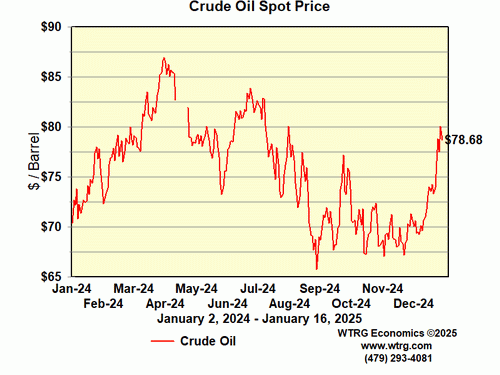
And as you can see from the chart above, those $60 and $70 a barrel levels may now be only a memory. Maybe.

Here's the other item of interest:

Huffington Post, August 3, 2006:
Global oil prices could hit $200 per barrel if the United States pursues sanctions against
Iran for its nuclear development program, an Iranian official told Venezuelan state TV on Thursday.

Iran's Foreign Relations Vice Minister Manuchehr Mohammadi said, "The first consequence of these sanctions would be an increase in the price of oil to around $200 per barrel."
Didn't the Kyle-Lieberman amendment authorize sanctions against Iran?

Now reread that article about the possibility of an attack on Iran causing the Straits of Hormuz to be closed and the effect that would have on the price of oil.

Labels: , , , ,

Web Site Counters
Staples Coupons