Monday, September 06, 2010

Retiring Chairman of Obama's Economic Council Totally Clueless

Some say the elite have no contact with the real world.

Washington Post: (via Cryptogon)
Economist Christina Romer serves up dismal news at her farewell luncheon

By Dana Milbank
Washington Post Staff Writer
Wednesday, September 1, 2010; 10:40 PM

Lunch at the National Press Club on Wednesday caused some serious indigestion.

It wasn't the food; it was the entertainment. Christina Romer, chairman of President Obama's Council of Economic Advisers, was giving what was billed as her "valedictory" before she returns to teach at Berkeley, and she used the swan song to establish four points, each more unnerving than the last:

She had no idea how bad the economic collapse would be. She still doesn't understand exactly why it was so bad. The response to the collapse was inadequate. And she doesn't have much of an idea about how to fix things.

What she did have was a binder full of scary descriptions and warnings, offered with a perma-smile and singsong delivery: "Terrible recession. . . . Incredibly searing. . . . Dramatically below trend. . . . Suffering terribly. . . . Risk of making high unemployment permanent. . . . Economic nightmare."

Anybody want dessert?

At week's end, Romer will leave the council chairmanship after what surely has been the most dismal tenure anybody in that post has had: a loss of nearly 4 million jobs in a year and a half. That's not Romer's fault; the financial collapse occurred before she, and Obama, took office. But she was the president's top economist during a time when the administration consistently underestimated the depth of the economy's troubles - miscalculations that have caused Americans to lose faith in the president and the Democrats.

Romer had predicted that Obama's stimulus package would keep the unemployment rate at 8 percent or less; it is now 9.5 percent. One of her bosses, Vice President Biden, told Democrats in January that "you're going to see, come the spring, net increase in jobs every month." The economy lost 350,000 jobs in June and July.

This is why nearly two-thirds of Americans think the country is on the wrong track - and why Obama's efforts to highlight the end of U.S. combat in Iraq and the resumption of Middle East peace talks have little chance of piercing the gloom as voters consider handing control of Congress back to the Republicans.

Romer's farewell luncheon had been scheduled for the club's ballroom, but attendance was light and the event was moved to a smaller room. Romer, wearing a green suit, read brightly from her text - a delivery at odds with the dark material she was presenting. When she and her colleagues began work, she acknowledged, they did not realize "how quickly and strongly the financial crisis would affect the economy." They "failed to anticipate just how violent the recession would be."

Even now, Romer said, mystery persists. "To this day, economists don't fully understand why firms cut production as much as they did or why they cut labor so much more than they normally would." Her defense was that "almost all analysts were surprised by the violent reaction."

That miscalculation, in turn, led to her miscalculation that the stimulus package would be enough to keep the unemployment rate from exceeding 8 percent. Without the policy, she had predicted, unemployment would soar to 9.5 percent. The plan passed, and unemployment went to 10 percent.

No wonder most Americans think the effort failed. But Romer argued, a bit too defensively, against the majority perception. "As the Council of Economic Advisers has documented in a series of reports to Congress, there is widespread agreement that the act is broadly on track," she declared. Further, she argued, "I will never regret trying to put analysis and quantitative estimates behind our policy recommendations."

But the problem is not that Romer did a quantitative analysis; the problem is that the quantitative analysis was wrong. Inevitably, this meant that, as she acknowledged, "the turnaround has been insufficient."

And what to do about this? Here, Romer became uncharacteristically hesitant to make predictions. She suggested some "innovative, low-cost policies." But the examples she cited - a "national export initiative," new trade agreements and a "pragmatic approach to regulation" - aren't exactly blockbusters.

"The only sure-fire ways for policymakers to substantially increase aggregate demand in the short run are for the government to spend more and tax less," she said. But asked about the main Republican proposal, extending George W. Bush's tax cuts for those earning more than $250,000, Romer replied that doing so would be "fiscally irresponsible."

The truth is that the Obama administration is pretty much out of options. Any major new effort would be blocked by Republicans, who have few alternatives of their own. "What we would all love to find - the inexpensive magic bullet to our economic troubles - the truth is it almost surely doesn't exist," Romer admitted.

The valedictory was becoming more of an elegy. At the end of the depressing forum, the moderator read a question submitted by a member of the audience: "You seem like you'd be a lot of fun at parties. Are you?"

The economist blushed. "You'll have to just take it for granted," she said.

Like 8 percent unemployment.

Labels: , , ,

Friday, September 03, 2010

The rigged card game that is the US Economy

Washingtonsblog:

Friday, September 3, 2010

Government Policy Caused the Drought of Unemployment


The unemployment rate has risen again for the the first time in 4 months. I predicted a growing, long-term unemployment problem last year.

Indeed, the government's actions have directly contributed to the rising tide of unemployment.

The Government Has Encouraged the Offshoring of American Jobs for More Than 50 Years

President Eisenhower re-wrote the tax laws so that they would favor investment abroad. President Kennedy railed against tax provisions that "consistently favor United States private investment abroad compared with investment in our own economy", but nothing changed.

For the last 60 years, the tax benefits to American companies making things abroad has encouraged jobs to move out of the U.S.

The Government Has Encouraged Mergers

The government has actively encouraged mergers, which destroy jobs.

For example, the Treasury Department encouraged banks to use the bailout money to buy their competitors, and pushed through an amendment to the tax laws which rewards mergers in the banking industry.

This is nothing new.

Citigroup's former chief executive says that when Citigroup was formed in 1998 out of the merger of banking and insurance giants, Alan Greenspan told him, “I have nothing against size. It doesn’t bother me at all”.

And the government has actively encouraged the big banks to grow into mega-banks.

The Government Has Let Unemployment Rise in an Attempt to Fight Inflation

As I noted last year:

The Federal Reserve is mandated by law to maximize employment. The relevant statute states:

The Board of Governors of the Federal Reserve System and the Federal Open Market Committee shall maintain long run growth of the monetary and credit aggregates commensurate with the economy's long run potential to increase production, so as to promote effectively the goals of maximum employment, stable prices, and moderate long-term interest rates.
***

The Fed could have stemmed the unemployment crisis by demanding that banks lend more as a condition to the various government assistance programs, but Mr. Bernanke failed to do so.

Ryan Grim argues that the Fed might have broken the law by letting unemployment rise in order to keep inflation low:

The Fed is mandated by law to maximize employment, but focuses on inflation -- and "expected inflation" -- at the expense of job creation. At its most recent meeting, board members bluntly stated that they feared banks might increase lending, which they worried could lead to inflation.

Board members expressed concern "that banks might seek to reduce appreciably their excess reserves as the economy improves by purchasing securities or by easing credit standards and expanding their lending substantially. Such a development, if not offset by Federal Reserve actions, could give additional impetus to spending and, potentially, to actual and expected inflation." That summary was spotted by Naked Capitalism and is included in a summary of the minutes of the most recent meeting...

Suffering high unemployment in order to keep inflation low cuts against the Fed's legal mandate. Or, to put it more bluntly, it may be illegal.

In fact, the unemployment situation is getting worse, and many leading economists say that - under Mr. Bernanke's leadership - America is suffering a permanent destruction of jobs.

For example, JPMorgan Chase’s Chief Economist Bruce Kasman told Bloomberg:

[We've had a] permanent destruction of hundreds of thousands of jobs in industries from housing to finance.
The chief economists for Wells Fargo Securities, John Silvia, says:

Companies “really have diminished their willingness to hire labor for any production level,” Silvia said. “It’s really a strategic change,” where companies will be keeping fewer employees for any particular level of sales, in good times and bad, he said.

And former Merrill Lynch chief economist David Rosenberg writes:
The number of people not on temporary layoff surged 220,000 in August and the level continues to reach new highs, now at 8.1 million. This accounts for 53.9% of the unemployed — again a record high — and this is a proxy for permanent job loss, in other words, these jobs are not coming back. Against that backdrop, the number of people who have been looking for a job for at least six months with no success rose a further half-percent in August, to stand at 5 million — the long-term unemployed now represent a record 33% of the total pool of joblessness.
And see this.
In fact, the Fed intentionally curbed lending by banks in an attempt to stem inflation.

The Government Has Allowed Wealth to be Concentrated in Fewer and Fewer Hands

As I pointed out a year ago:

A new report by University of California, Berkeley economics professor Emmanuel Saez concludes that income inequality in the United States is at an all-time high, surpassing even levels seen during the Great Depression.

The report shows that:

  • Income inequality is worse than it has been since at least 1917
  • "The top 1 percent incomes captured half of the overall economic growth over the period 1993-2007"
  • "In the economic expansion of 2002-2007, the top 1 percent captured two thirds of income growth."

As others have pointed out, the average wage of Americans, adjusting for inflation, is lower than it was in the 1970s. The minimum wage, adjusting for inflation, is lower than it was in the 1950s. See this. On the other hand, billionaires have never had it better.

As I wrote in September:

The economy is like a poker game . . . it is human nature to want to get all of the chips, but - if one person does get all of the chips - the game ends.

In other words, the game of capitalism only continues as long as everyone has some money to play with. If the government and corporations take everyone's money, the game ends.

The fed and Treasury are not giving more chips to those who need them: the American consumer. Instead, they are giving chips to the 800-pound gorillas at the poker table, such as Wall Street investment banks. Indeed, a good chunk of the money used by surviving mammoth players to buy the failing behemoths actually comes from the Fed...

This is not a question of big government versus small government, or republican versus democrat. It is not even a question of Keynes versus Friedman (two influential, competing economic thinkers).

It is a question of focusing any government funding which is made to the majority of poker players - instead of the titans of finance - so that the game can continue. If the hundreds of billions or trillions spent on bailouts had instead been given to ease the burden of consumers, we would have already recovered from the financial crisis.

I noted in April:

FDR’s Fed chairman Marriner S. Eccles explained:

As in a poker game where the chips were concentrated in fewer and fewer hands, the other fellows could stay in the game only by borrowing. When their credit ran out, the game stopped.

***

When most people lose their poker chips - and the game is set up so that only those with the most chips get more - free market capitalism is destroyed, as the "too big to fails" crowd out everyone else.

And the economy as a whole is destroyed. Remember, consumer spending accounts for the lion's share of economic activity. If most consumers are out of chips, the economy slumps.

And unemployment soars.

As former Secretary of Labor Robert Reich wrote yesterday:

Where have all the economic gains gone? Mostly to the top.

***

It’s no coincidence that the last time income was this concentrated was in 1928. I do not mean to suggest that such astonishing consolidations of income at the top directly cause sharp economic declines. The connection is more subtle.

The rich spend a much smaller proportion of their incomes than the rest of us. So when they get a disproportionate share of total income, the economy is robbed of the demand it needs to keep growing and creating jobs.

What’s more, the rich don’t necessarily invest their earnings and savings in the American economy; they send them anywhere around the globe where they’ll summon the highest returns — sometimes that’s here, but often it’s the Cayman Islands, China or elsewhere. The rich also put their money into assets most likely to attract other big investors (commodities, stocks, dot-coms or real estate), which can become wildly inflated as a result.

***

THE Great Depression and its aftermath demonstrate that there is only one way back to full recovery: through more widely shared prosperity.

***

And as America’s middle class shared more of the economy’s gains, it was able to buy more of the goods and services the economy could provide. The result: rapid growth and more jobs. By contrast, little has been done since 2008 to widen the circle of prosperity.

So through it's policies encouraging the offshoring of jobs, mergers, decreasing of economic activity to fight inflation, and allowing wealth to be concentrated in fewer and fewer hands, the government has channeled water away from U.S. jobs, creating the worsening unemployment drought.

Note for Keynesians: As I have repeatedly explained, the government hasn't spent money on the right kind of things to stimulate employment. See this and this.


Labels: , ,

Thursday, August 26, 2010

Ian Welsh explains how the right thing morally is usually also the best thing practically

This is so true, and the fact that it's commonly ignored is so sad...

The right thing to do

2010 August 25

What makes me saddest of all things in the world is this: the vast majority of the time the right thing to do morally is the right thing to do in terms of broad self-interest, and yet we don’t believe that and we do the wrong thing, thinking we must, thinking that we’re making the “hard decisions”.

This spans the spectrum of issues. It doesn’t matter whether you’re talking about foreign affairs, where the money used on Iraq and Afghanistan could have rebuilt America and made it more prosperous. It doesn’t matter if you’re talking about health care, where everyone knew that the right thing to do was single payer or some other form of comprehensive healthcare, which would have reduced bankruptcies massively, saved 6% of GDP and massive numbers of lives. It doesn’t matter if you’re talking about the financial crisis, where criminally prosecuting those who engaged in fraud (the entire executive class of virtually ever major financial firm) and nationalizing the major banks, wiping out the shareholders and making the bondholders eat their losses was the right thing to do, and didn’t happen. It doesn’t matter if you’re talking about drug policy, where the “war on drugs” has accomplished nothing except destabilizing multiple countries and giving the US the largest prison population proportional to population in the entire world and where legalizing marijuana, soft opiates and coca leaves would save billions of dollars, reduce violence, help stabilize Mexico and would help tax receipts. It doesn’t matter if you’re talking about food, where we subsidize the most unhealthy foods possible and engage in practices which have reduced the nutritional content of food by 40% in the last half century. It doesn’t matter if you’re talking about environmental pollutants, which have contributed to a massive rise in chronic diseases so great it amounts to an epidemic.

And on, and on, and on.

Now the fact is that there is no free lunch. When you spend money on war, you can’t spend it on education or health or crumbling infrasture or civilian technology. When you allow oligopolies to control the marketplace and buy up politicians, the cost of that is a decreased standard of living. When you refuse to deal effective with externalized health pollution, whether from soda pop or carcinogens, you pay for that with the death of people you care for from heart disease, cancer and other illnesses.

The response is “we have to do this to protect ourselves/to make a profit”.

No, you don’t. America would be more prosperous and just as safe if you didn’t waste trillions on wars and a bloated military whose purpose isn’t to protect you but to beat on foreigners (who is going to invade the US? No one. Next.) You would be happier if you did not allow health pollution because you and your loved ones would be healthier and it’s damn hard to be happy when you or your loved ones get cancer, or diabetes, or asthma and so on. Cheap consumer goods do not make up for it and the costs are so high that it’s questionable that the consumer goods ARE cheap—you’re just paying for them in illness and health care bills.

All of these things are moral wrongs. We know it’s wrong to invade other countries that haven’t attacked us. We know that it’s wrong to put illness inducing substances into the air or food. We know that we shouldn’t subsidize high fructose corn syrup and that if we’re going to subsidize food we should subsidize healthy food. We know that’s immoral, yet we do it anyway.

One of the great ironies of human society is that we create it ourselves, but as individuals and even groups we feel powerless to control what we created. We forged our own chains, and can’t get out of them.

But the first step to freeing ourselves from our chains is to stop telling ourselves that the moral thing to do isn’t the right thing to do in practical terms. The right thing to do… is the right thing to do. When we refuse to do the right thing, instead we impoverish ourselves and our loved ones, we make ourselves sick and we kill ourselves. When we do horrible things to other people, we make them hate us, and then they try and do horrible things to us.

Doing the wrong thing, the immoral thing, is almost never the practical thing if you care about the well-being of yourself, your children, your friends and your family. It always blows back. If you’re lucky, you may die before the cost comes to bear, but that’s only if you’re lucky, and in the American context, if you aren’t dead yet, you probably aren’t going to get lucky.

So do the right thing. Not just because it is the right thing morally, but because it’s the right thing to do for you and your loved ones in a very practical way.

Labels: , , , , , ,

Sunday, August 15, 2010

"Financial Reform" Virtually Useless

ConsortiumNews.com:
US Staggers Toward Dysfunction

Danny Schechter
August 14, 2010

[. . .]

The private sector is not creating jobs. The GOP is blocking the government from doing more stimulus programs while the system seems to be unraveling.

All the talk of cutting deficits by conservatives or ending tax cuts by liberals will not give the economy the boost it needs. There is a paralysis of analysis and a stalemate.

The markets were more freaked by the recent pessimism oozing from the Fed than any partisan punditry. The slowdown they are worried about has already doomed any heavily-hyped “recovery.”

And the public knows it, according to the recent polls.

What’s worse is that the tea leaves offer few signs of a turnaround any time soon even if General Motors is selling more cars — many, may we be reminded, in China.

(The GM CEO who last week took a nasty ingrate smack at GM being perceived as “Government Motors,” demanding the government sell all of its shares, has just announced he is leaving! I wonder why?)

The Carlyle Group is taking over while the automaker launches a new program of subprime lending, the very predatory deal-making that got them in trouble in the first place.

Does anyone ever learn from history, or care about how communities are being destroyed as a financial crisis becomes a social crisis at the grassroots level?

Check out what happened at that mall in Atlanta where thousands of people nearly rioted to get on a public housing waiting list.

The Congress returned from its recess to pass new monies to keep teachers teaching and cops patrolling. They did so by slashing food stamps so the unemployed and poor will have to cut back further.

What a trade-off.

As for insuring the stability of an increasingly volatile system, will the new financial reforms make any difference? It doesn’t look like it.

The New York Times reported, “As Wall Street scrambles to find the best and most profitable way to operate under the new financial reform law, Goldman Sachs Group Inc. — the firm that was expected to suffer the most under the legislation — could emerge practically unscathed.”

"We think we are well positioned to be a market leader under the new rules,” Jack McCabe, co-head of Goldman's derivatives clearing service business, was quoted as saying.

As for the law’s effect on Goldman, Richard Bove, a bank analyst at Rochdale Securities, said he had changed his view.

"I thought this company was going to be really harmed by this bill; now I've figured out that it's not going to happen," he said. "They should win big here."

That’s Goldman’s reason to celebrate its “big win” What about the others?

The truth is we will not know for a awhile, for a long while, for many, many years. So much for any sense of urgency even after former Federal Reserve Chairman Paul Volcker said we are running out of time.

Bloomberg News explained why

“Many of the measures ordered by Congress and global regulators, aimed at cushioning the financial system in future crises, are years away from being implemented. The Basel Committee on Banking Supervision plans to give the world’s banks until 2018 to comply with limits on how much they can borrow.

“Parts of the Volcker rule, a provision of the new Dodd-Frank Act that would force firms to cut stakes in in-house hedge funds and private-equity units, may not go into effect for a dozen years.”

“Based on our experience of government’s ability to execute these things effectively and in a timely way, we are almost uncovered now from any future financial risk for at least another 8 or 10 years, and that’s a little scary,” said Roy Smith, finance professor at New York University’s Stern School of Business and a former banker at Goldman Sachs Group Inc.

Economist Nouriel Roubini, one of the first to forecast our crisis, worries that major economies in Europe are at risk and could fall.

At the same time I am reading articles that contend, “The US is more bankrupt than Greece.” Another reports the IMF saying the US is bankrupt but most Americans don’t know it.

What else don’t we know?

At the same time, the folks who brought us this crisis are still riding high, making multi-million dollar “settlements” to cover up fraudulent practices. In recent weeks, Goldman Sachs, Countrywide and, now, Wells Fargo have just done that in part to avoid prosecutions.

Their CEOS are going on vacation to spend their ill-gotten gains, not to jail to pay for their crimes. And the “professional left” — whatever that is supposed to be – is more pissed at Robert Gibbs blathering at that podium than the banksters maneuvering behind the scenes.

Can anyone tell me what’s wrong with this picture?

Labels: , ,

Sunday, July 18, 2010

Con of the Decade, parts 1 and 2

Charles Hugh Smith:


The Con of the Decade Part I (July 8, 2010)


The con of the decade (Part I) involves the transfer of private debt to the public (the marks), who then pays interest forever to the con artists.

I've laid out the Con of the Decade (Part I) in outline form:

1. Enable trillions of dollars in mortgages guaranteed to default by packaging unlimited quantities of them into mortgage-backed securities (MBS), creating umlimited demand for fraudulently originated loans.

2. Sell these MBS as "safe" to credulous investors, institutions, town councils in Norway, etc., i.e. "the bezzle" on a global scale.

3. Make huge "side bets" against these doomed mortgages so when they default then the short-side bets generate billions in profits.

4. Leverage each $1 of actual capital into $100 of high-risk bets.

5. Hide the utterly fraudulent bets offshore and/or off-balance sheet (not that the regulators you had muzzled would have noticed anyway).

6. When the longside bets go bad, transfer hundreds of billions of dollars in Federal guarantees, bailouts and backstops into the private hands which made the risky bets, either via direct payments or via proxies like AIG. Enable these private Power Elites to borrow hundreds of billions more from the Treasury/Fed at zero interest.

7. Deposit these funds at the Federal Reserve, where they earn 3-4%. Reap billions in guaranteed income by borrowing Federal money for free and getting paid interest by the Fed.

8. As profits pile up, start buying boatloads of short-term U.S. Treasuries. Now the taxpayers who absorbed the trillions in private losses and who transferred trillions in subsidies, backstops, guarantees, bailouts and loans to private banks and corporations, are now paying interest on the Treasuries their own money purchased for the banks/corporations.

9. Slowly acquire trillions of dollars in Treasuries--not difficult to do as the Federal government is borrowing $1.5 trillion a year.

10. Stop buying Treasuries and dump a boatload onto the market, forcing interest rates to rise as supply of new T-Bills exceeds demand (at least temporarily). Repeat as necessary to double and then triple interest rates paid on Treasuries.

11. Buy hundreds of billions in long-term Treasuries at high rates of interest. As interest rates rise, interest payments dwarf all other Federal spending, forcing extreme cuts in all other government spending.

12. Enjoy the hundreds of billions of dollars in interest payments being paid by taxpayers on Treasuries that were purchased with their money but which are safely in private hands.

Since the Federal government could potentially inflate away these trillions in Treasuries, buy enough elected officials to force austerity so inflation remains tame. In essence, these private banks and corporations now own the revenue stream of the Federal government and its taxpayers. Neat con, and the marks will never understand how "saving our financial system" led to their servitude to the very interests they bailed out.

The circle is now complete: in "saving our financial system," the public borrowed trillions and transferred the money to private Power Elites, who then buy the public debt with the money swindled out of the taxpayer. Then the taxpayers transfer more wealth every year to the Power Elites/Plutocracy in the form of interest on the Treasury debt. The Power Elites will own the debt that was taken on to bail them out of bad private bets: this is the culmination of privatized gains, socialized risk.

In effect, it's a Third World/colonial scam on a gigantic scale: plunder the public treasury, then buy the debt which was borrowed and transferred to your pockets. You are buying the country with money you borrowed from its taxpayers. No despot could do better.


I would like to acknowledge Allan Dover and B.C. of Imperial Economics for helping to clarify my thinking on these topics.


The Con of the Decade Part II (July 9, 2010)


The con of the decade (Part II) involves sheltering the Power Elites' income while raising taxes on the debt-serfs to pay the interest owed the Power Elites.

The Con of the Decade (Part II) meshes neatly with the first Con of the Decade. Yesterday I described how the financial Plutocracy can transfer ownership of the Federal government's income stream via using the taxpayer's money to buy the debt that the taxpayers borrowed to bail out the Plutocracy.

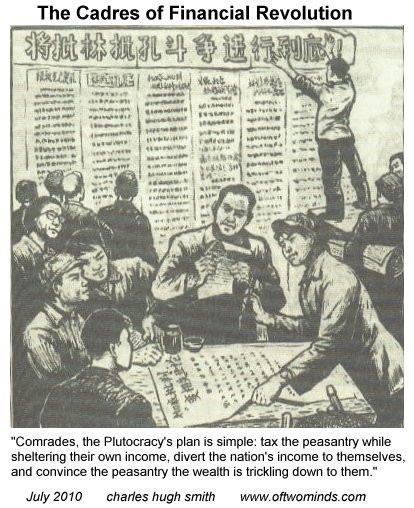
In order for the con to work, however, the Power Elites and their politico toadies in Congress, the Treasury and the Fed must convince the peasantry that low tax rates on unearned income are not just "free market capitalism at its best" but that they are also "what the country needs to get moving again."

The first step of the con was successfully fobbed off on the peasantry in 2001: lower the taxes paid by the most productive peasants marginally while massively lowering the effective taxes paid by the financial Plutocracy.

One Year Later, No Sign of Improvement in America's Income Inequality Problem:

Income inequality has grown massively since 2000. According to Harvard Magazine, 66% of 2001-2007's income growth went to the top 1% of Americans, while the other 99% of the population got a measly 6% increase. How is this possible? One thing to consider is that in 2001, George W. Bush cut $1.3 trillion in taxes, and 32.6% of the cut went to the top 1%. Another factor is Bush's decision to increase the national debt from $5 trillion to $11 trillion. The combination of increased government spending and lower taxes helped the top 1% considerably.

The second part of the con is to mask much of the Power Elites' income streams behind tax shelters and other gaming-of-the-system so the advertised rate appears high to the peasantry but the effective rate paid on total income is much much lower.

The tax shelters are so numerous and so effective that it takes thousands of pages of tax codes and armies of toadies to pursue them all: family trusts, oil depletion allowances, tax-free bonds and of course special one-off tax breaks arranged by "captured" elected officials.

Step three is to convince the peasantry that $600 in unearned income (capital gains) should be taxed in the same way as $600 million. The entire key to the U.S. tax code is to tax earned income heavily but tax unearned income (the majority of the Plutocracy's income is of course unearned) not at all or very lightly.

In a system which rewarded productive work and provided disincentives to rampant speculation and fraud, the opposite would hold: unearned income would be taxed at much higher rates than earned income, which would be taxed lightly, especially at household incomes below $100,000.

If the goal were to encourage "investing" while reining in the sort of speculations which "earn" hedge fund managers $600 million each (no typo, that was the average of the top 10 hedgies' personal take of their funds gains), then all unearned income (interest, dividends, capital gains, rents from property, oil wells, etc.) up to $6,000 a year would be free--no tax. Unearned income between $6,000 and $60,000 would be taxed at 20%, roughly half the top rate for earned income. This would leave 95% of U.S. households properly encouraged to invest via low tax rates.

Above $60,000, then unearned income would be taxed the same as earned income, and above $1 million (the top 1/10 of 1% of households) then it would be taxed at 50%. Above $10 million, it would be taxed at 60%. Such a system would offer disincentives to the speculative hauls made by the top 1/10 of 1% while encouraging investing in the lower 99%.

Could such a system actually be passed into law and enforced by a captured, toady bureaucracy and Congress? Of course not. But it is still a worthy exercise to take apart the rationalizations being offered to justify rampant speculative looting, collusion, corruption and fraud.

The last step of the con is to raise taxes on the productive peasantry to provide the revenues needed to pay the Plutocracy its interest on Treasuries. If the "Bush tax cuts" are repealed, the actual effective rates paid on unearned income will remain half (20%) of the rates on earned income (wages, salaries, profits earned from small business, etc.) which are roughly 40% at higher income levels.

The financial Plutocracy will champion the need to rein in Federal debt, now that they have raised the debt via plundering the public coffers and extended ownership over that debt.

Now the con boils down to insuring the peasantry pay enough taxes to pay the interest on the Federal debt--interest which is sure to rise considerably. The 1% T-Bill rates were just part of the con to convince the peasantry that trillions of dollars could be borrowed "with no consequences." Those rates will steadily rise once the financial Power Elites own enough of the Treasury debt. Then the game plan will be to lock in handsome returns on long-term Treasuries, and command the toady politicos to support "austerity."

The austerity will not extend to the financial Elites, of course. That's the whole purpose of the con. "Some are more equal than others," indeed.

Labels: , ,

Monday, June 28, 2010

Krugman Agrees with Hudson, but I suspect he doesn't know it...

NYTimes.com:

The Third Depression

Recessions are common; depressions are rare. As far as I can tell, there were only two eras in economic history that were widely described as “depressions” at the time: the years of deflation and instability that followed the Panic of 1873 and the years of mass unemployment that followed the financial crisis of 1929-31.

Neither the Long Depression of the 19th century nor the Great Depression of the 20th was an era of nonstop decline — on the contrary, both included periods when the economy grew. But these episodes of improvement were never enough to undo the damage from the initial slump, and were followed by relapses.

We are now, I fear, in the early stages of a third depression. It will probably look more like the Long Depression than the much more severe Great Depression. But the cost — to the world economy and, above all, to the millions of lives blighted by the absence of jobs — will nonetheless be immense.

And this third depression will be primarily a failure of policy. Around the world — most recently at last weekend’s deeply discouraging G-20 meeting — governments are obsessing about inflation when the real threat is deflation, preaching the need for belt-tightening when the real problem is inadequate spending.

In 2008 and 2009, it seemed as if we might have learned from history. Unlike their predecessors, who raised interest rates in the face of financial crisis, the current leaders of the Federal Reserve and the European Central Bank slashed rates and moved to support credit markets. Unlike governments of the past, which tried to balance budgets in the face of a plunging economy, today’s governments allowed deficits to rise. And better policies helped the world avoid complete collapse: the recession brought on by the financial crisis arguably ended last summer.

But future historians will tell us that this wasn’t the end of the third depression, just as the business upturn that began in 1933 wasn’t the end of the Great Depression. After all, unemployment — especially long-term unemployment — remains at levels that would have been considered catastrophic not long ago, and shows no sign of coming down rapidly. And both the United States and Europe are well on their way toward Japan-style deflationary traps.

In the face of this grim picture, you might have expected policy makers to realize that they haven’t yet done enough to promote recovery. But no: over the last few months there has been a stunning resurgence of hard-money and balanced-budget orthodoxy.

As far as rhetoric is concerned, the revival of the old-time religion is most evident in Europe, where officials seem to be getting their talking points from the collected speeches of Herbert Hoover, up to and including the claim that raising taxes and cutting spending will actually expand the economy, by improving business confidence. As a practical matter, however, America isn’t doing much better. The Fed seems aware of the deflationary risks — but what it proposes to do about these risks is, well, nothing. The Obama administration understands the dangers of premature fiscal austerity — but because Republicans and conservative Democrats in Congress won’t authorize additional aid to state governments, that austerity is coming anyway, in the form of budget cuts at the state and local levels.

Why the wrong turn in policy? The hard-liners often invoke the troubles facing Greece and other nations around the edges of Europe to justify their actions. And it’s true that bond investors have turned on governments with intractable deficits. But there is no evidence that short-run fiscal austerity in the face of a depressed economy reassures investors. On the contrary: Greece has agreed to harsh austerity, only to find its risk spreads growing ever wider; Ireland has imposed savage cuts in public spending, only to be treated by the markets as a worse risk than Spain, which has been far more reluctant to take the hard-liners’ medicine.

It’s almost as if the financial markets understand what policy makers seemingly don’t: that while long-term fiscal responsibility is important, slashing spending in the midst of a depression, which deepens that depression and paves the way for deflation, is actually self-defeating.

So I don’t think this is really about Greece, or indeed about any realistic appreciation of the tradeoffs between deficits and jobs. It is, instead, the victory of an orthodoxy that has little to do with rational analysis, whose main tenet is that imposing suffering on other people is how you show leadership in tough times.

And who will pay the price for this triumph of orthodoxy? The answer is, tens of millions of unemployed workers, many of whom will go jobless for years, and some of whom will never work again.

Labels: ,

Europe’s Fiscal Dystopia: The “New Austerity” Road to Neoserfdom

Michael Hudson at NewEconomicPerspectives.blogspot.com:

Somebody must take a loss on the economy's bad loans – and bankers want the economy to take the loss, to "save the financial system." From the financial sector's vantage point, the economy is to be managed to preserve bank liquidity, rather than the financial system run to serve the economy. Government social spending (on everything apart from bank bailouts and financial subsidies) and disposable personal income are to be cut back to keep the debt overhead from being written down. Corporate cash flow is to be used to pay creditors, not employ more labor and make long-term capital investment.

The economy is to be sacrificed to subsidize the fantasy that debts can be paid, if only banks can be "made whole" to begin lending again – that is, to resume loading the economy down with even more debt, causing yet more intrusive debt deflation.

This is not the familiar old 19th-century class war of industrial employers against labor, although that is part of what is happening. It is above all a war of the financial sector against the "real" economy: industry as well as labor.

The underlying reality is indeed that pensions cannot be paid – at least, not paid out of financial gains. For the past fifty years the Western economies have indulged the fantasy of paying retirees out of purely financial gains (M-M' as Marxists would put it), not out of an expanding economy (M-C-M', employing labor to produce more output). The myth was that finance would take the form of productive loans to increase capital formation and hiring. The reality is that finance takes the form of debt – and gambling. Its gains therefore were made from the economy at large. They were extractive, not productive. Wealth at the rentier top of the economic pyramid shrank the base below. So something has to give. The question is, what form will the "give" take? And who will do the giving – and be the recipients?

The Greek government has been unwilling to tax the rich. So labor must make up the fiscal gap, by permitting its socialist government to cut back pensions, health care, education and other social spending – all to bail out the financial sector from an exponential growth that is impossible to realize in practice. The economy is being sacrificed to an impossible dream. Yet instead of blaming the problem on the exponential growth in bank claims that cannot be paid, bank lobbyists – and the G-20 politicians dependent on their campaign funding – are promoting the myth that the problem is demographic: an aging population expecting Social Security and employer pensions. Instead of paying these, governments are being told to use their taxing and credit-creating power to bail out the financial sector's claims for payment.

Latvia has been held out as the poster child for what the EU is recommending for Greece and the other PIIGS: Slashing public spending on education and health has reduced public-sector wages by 30 percent, and they are still falling. Property prices have fallen by 70 percent – and homeowners and their extended family of co-signers are liable for the negative equity, plunging them into a life of debt peonage if they do not take the hint and emigrate.

The bizarre pretense for government budget cutbacks in the face of a post-bubble economic downturn is that it will help to rebuild "confidence." It is as if fiscal self-destruction can instill confidence rather than prompting investors to flee the euro. The logic seems to be the familiar old class war, rolling back the clock to the hard-line tax philosophy of a bygone era – rolling back Social Security and public pensions, rolling back public spending on education and other basic needs, and above all, increasing unemployment to drive down wage levels. This was made explicit by Latvia's central bank – which EU central bankers hold up as a "model" of economic shrinkage for other countries to follow.

It is a self-destructive logic. Exacerbating the economic downturn will reduce tax revenues, making budget deficits even worse in a declining spiral. Latvia's experience shows that the response to economic shrinkage is emigration of skilled labor and capital flight. Europe's policy of planned economic shrinkage in fact controverts the prime assumption of political and economic textbooks: the axiom that voters act in their self-interest, and that economies choose to grow, not to destroy themselves. Today, European democracies – and even the Social Democratic, Socialist and labour Parties – are running for office on a fiscal and financial policy platform that opposes the interests of most voters, and even industry.

The explanation, of course, is that today's economic planning is not being done by elected representatives. Planning authority has been relinquished to the hands of "independent" central banks, which in turn act as the lobbyists for commercial banks selling their product – debt. From the central bank's vantage point, the "economic problem" is how to keep commercial banks and other financial institutions solvent in a post-bubble economy. How can they get paid for debts that are beyond the ability of many people to pay, in an environment of rising defaults?

The answer is that creditors can get paid only at the economy's expense. The remaining economic surplus must go to them, not to capital investment, employment or social spending.

This is the problem with the financial view. It is short-term – and predatory. Given a choice between operating the banks to promote the economy, or running the economy to benefit the banks, bankers always will choose the latter alternative. And so will the politicians they support.

Governments need huge sums to bail out the banks from their bad loans. But they cannot borrow more, because of the debt squeeze. So the bad-debt loss must be passed onto labor and industry. The cover story is that government bailouts will permit the banks to start lending again, to reflate the Bubble Economy's Ponzi-borrowing. But there is already too much negative equity and there is no leeway left to restart the bubble. Economies are all "loaned up." Real estate rents, corporate cash flow and public taxing power cannot support further borrowing – no matter how much wealth the government gives to banks. Asset prices have plunged into negative equity territory. Debt deflation is shrinking markets, corporate profits and cash flow. The Miracle of Compound Interest dynamic has culminated in defaults, reflecting the inability of debtors to sustain the exponential rise in carrying charges that "financial solvency" requires.

If the financial sector can be rescued only by cutting back social spending on Social Security, health care and education, bolstered by more privatization sell-offs, is it worth the price? To sacrifice the economy in this way would violate most peoples' social values of equity and fairness rooted deep in Enlightenment philosophy.

That is the political problem: How can bankers persuade voters to approve this under a democratic system? It is necessary to orchestrate and manage their perceptions. Their poverty must be portrayed as desirable – as a step toward future prosperity.

A half-century of failed IMF austerity plans imposed on hapless Third World debtors should have dispelled forever the idea that the way to prosperity is via austerity. The ground has been paved for this attitude by a generation of purging the academic curriculum of knowledge that there ever was an alternative economic philosophy to that sponsored by the rentier Counter-Enlightenment. Classical value and price theory reflected John Locke's labor theory of property: A person's wealth should be what he or she creates with their own labor and enterprise, not by insider dealing or special privilege.

This is why I say that Europe is dying. If its trajectory is not changed, the EU must succumb to a financial coup d'êtat rolling back the past three centuries of Enlightenment social philosophy. The question is whether a break-up is now the only way to recover its social democratic ideals from the banks that have taken over its central planning organs.

Labels: , , ,

Saturday, June 26, 2010

The Housing Bubble Was Based On Fraud

Once again:

Recent filings by two Federal Home Loan Banks — in San Francisco and Seattle — offer an intriguing way to clear this high hurdle. Lawyers representing the banks, which bought mortgage securities, combed through the loan pools looking for discrepancies between actual loan characteristics and how they were pitched to investors.

You may not be shocked to learn that the analysis found significant differences between what the Home Loan Banks were told about these securities and what they were sold.

The rate of discrepancies in these pools is surprising. The lawsuits contend that half the loans were inaccurately described in disclosure materials filed with the Securities and Exchange Commission.

Half of them were fraudulent.

Half

There would have been no housing bubble without widespread fraud. None.

Virtually every major bank executive in the US should be indicted for fraud. The fact that there aren’t even serious investigations, let alone indictments, tells you everything you need to know. Everyone in the system knows it was all fraud, they knew it at the time, and that is exactly why there are no real investigations.

Labels: , , ,

Tuesday, March 30, 2010

Citibank Takes the US to the Cleaners

Oh Citibank, how many ways to you game the system? This dovetails nicely with that post about conning America.

Beat the Press (Dean Baker):
March 28, 2010

Did the Federal Government Make Money Bailing Out Citigroup?

The Washington Post is anxious to tell its readers that the government made a profit on its bailout of Citigroup. This claim gives a whole new meaning to the notion of "profit." The government gave enormous amounts of money to Citigroup through various direct and indirect channels. It is only getting a portion of this money back in its "profits," the rest is going to Citigroup's shareholders (e.g. Robert Rubin) and its millionaire executives who are highly skilled at getting the government to hand them money.

First, it is worth noting how the government got the shares of common stock which it is now selling for a profit. On November 23, 2008, the government bought $20 billion in preferred shares in Citigroup. It also received another $7 billion in preferred shares in exchange for guarantees on $300 billion in bad assets. At the time, the combined value of the investment in preferred shares and the guarantee on bad assets exceeded the full market value of Citigroup stock on November 21st, the last trading day prior to the deal. In other words, for the same financial commitment that the government made on that day, it could have owned Citigroup outright.

The government subsequently held onto to its preferred shares until Citigroup's stock had nearly tripled in value. In September of last year it traded its preferred shares for common shares that were priced at a level that only give the government a 27 percent stake in Citigroup. These shares have have now risen enough to give the government an $8 billion profit on its investment. While the Post tells readers that:

"The windfall expected from the stock sale would amount to a validation of the rescue plan adopted by government officials during the height of the financial panic, when the banking system neared the brink of collapse. A year ago, Citigroup's stock hovered around a dollar a share, and the bank's future seemed in doubt. On Friday, the stock closed at $4.31."

The logic of the Post's assertion that the profit on Citigroup stock validated the bailout is not clear. By making capital available to Citigroup at below market rates, the government effectively subsidized the income of Citigroup's shareholders. It also allowed its top executives to make millions of dollars because they were smart enough to be able to get taxpayers to subsidize the bank. The current market value of Citigroup is $123 billion, with only $33 billion belonging to the government. This means that the government has effectively given $90 billion (@ 25 million kid-years of health care provided through the State Children's Health Insurance Program or SCHIP) to Citigroup's shareholders and billions more to its executives by not demanding a market price for its support.

It is also worth noting that the government has supported Citigroup through other mechanisms. The Fed created various special lending facilities that allowed Citigroup to borrow money from the government at extremely low interest rates. Since one of the main uses of this money was buying government bonds, Citigroup was essentially getting free money from the government. If it borrowed $200 billion at near zero interest and lent it back to the government by buying 10-year Treasury bonds at 3.7 percent interest, then the government was effectively handing Citigroup $7.4 billion a year for nothing. This money is not deducted from the Post's estimate of the government's "profit" on its dealings with Citigroup. (The Fed refuses to tell the public how much money it lent to Citigroup and other banks at below market rates.)

It is possible that the losses at Fannie Mae and Freddie Mac, as well as the Federal Housing Authority (FHA), may also have helped to subsidize Citigroup's profits. Fannie and Freddie lose money when they pay too much to banks to buy mortgages. It is likely that Citigroup was one of the banks that Fannie and Freddie overpaid for mortgages. Similarly, the FHA loses money when it guarantees mortgages without charging a high enough insurance fee. It is likely that many of the mortgages that the FHA guaranteed, which went bad, were issued by Citigroup.

It is also worth noting that government policy has helped to boost Citigroup's profitability in other ways. Citigroup is at the top of the list of "too big to fail" institutions. This has allowed it to continue to borrow money from the private investors at interest rates that are far below the rates it would have to pay if it did not rely on a guarantee of support from the nanny state.

Also, the government's efforts to support the economy more generally have proven a boon to Citigroup. Specifically, by pushing down interest rates it has enormously raised the value of the loans on Citigroup's books. The value of long-term loans rises substantially when interest rates fall. If the Fed's program of buying mortgage-backed securities lowered the interest rate on 30-year mortgages from 5.5 percent to 5.0 percent, then this would raise the value of Citigroup's outstanding 30-year mortgages by more than 7 percent. If Citi had $500 billion invested in mortgages or related assets, then the action by the Fed would have effectively given Citi $35 billion.

If the Fed subsequently resells the $1.25 trillion in mortgage-backed securities it purchased in order to push down mortgage interest rates in an environment in which interest rates have risen, then it will lose money on these purchases. If it sells the mortgage-backed securities when interest rates are 6 percent, then it will lose close to 15 percent, or more than $180 billion on its purchases of these mortgages.

In telling readers that the profit on Citi stock "would amount to a validation of the rescue plan adopted by government officials during the height of the financial panic" the Post is ignoring all the other costs born by the government in allowing Citigroup to be restored to viability. It is also ignoring the enormous handout of taxpayer dollars to some of the richest people in the country. This is not good reporting.

--Dean Baker

Labels: , , ,

Break Up the Too Big To Fail Banks, say Financial Experts (Except those in charge)


Washington's Blog
:

Dodd's Financial "Reform" Bill Is Nothing but a Placebo for a Very Sick Economy

On March 3rd, Richard Fisher - President of the Federal Reserve Bank of Dallas - told the Council on Foreign Relations:

A truly effective restructuring of our regulatory regime will have to neutralize what I consider to be the greatest threat to our financial system’s stability—the so-called too-big-to-fail, or TBTF, banks. In the past two decades, the biggest banks have grown significantly bigger. In 1990, the 10 largest U.S. banks had almost 25 percent of the industry’s assets. Their share grew to 44 percent in 2000 and almost 60 percent in 2009.

The existing rules and oversight are not up to the acute regulatory challenge imposed by the biggest banks. First, they are sprawling and complex—so vast that their own management teams may not fully understand their own risk exposures. If that is so, it would be futile to expect that their regulators and creditors could untangle all the threads, especially under rapidly changing market conditions. Second, big banks may believe they can act recklessly without fear of paying the ultimate penalty. They and many of their creditors assume the Fed and other government agencies will cushion the fall and assume the damages, even if their troubles stem from negligence or trickery. They have only to look to recent experience to confirm that assumption.

Some argue that bigness is not bad, per se. Many ask how the U.S. can keep its competitive edge on the global stage if we cede LFI territory to other nations—an argument I consider hollow given the experience of the Japanese and others who came to regret seeking the distinction of having the world’s biggest financial institutions. I know this much: Big banks interact with the economy and financial markets in a multitude of ways, creating connections that transcend the limits of industry and geography. Because of their deep and wide connections to other banks and financial institutions, a few really big banks can send tidal waves of troubles through the financial system if they falter, leading to a downward spiral of bad loans and contracting credit that destroys many jobs and many businesses.

The dangers posed by TBTF banks are too great. To be sure, having a clearly articulated “resolution regime” would represent steps forward, though I fear they might provide false comfort in that a special resolution treatment for large firms might be viewed favorably by creditors, continuing the government-sponsored advantage bestowed upon them. Given the danger these institutions pose to spreading debilitating viruses throughout the financial world, my preference is for a more prophylactic approach: an international accord to break up these institutions into ones of more manageable size—more manageable for both the executives of these institutions and their regulatory supervisors. I align myself closer to Paul Volcker in this argument and would say that if we have to do this unilaterally, we should. I know that will hardly endear me to an audience in New York, but that’s how I see it. Winston Churchill said that “in finance, everything that is agreeable is unsound and everything that is sound is disagreeable.” I think the disagreeable but sound thing to do regarding institutions that are TBTF is to dismantle them over time into institutions that can be prudently managed and regulated across borders. And this should be done before the next financial crisis, because it surely cannot be done in the middle of a crisis.

Fisher joints many other top economists and financial experts believe that the economy cannot recover unless the big, insolvent banks are broken up in an orderly fashion, including:

  • Dean and professor of finance and economics at Columbia Business School, and chairman of the Council of Economic Advisers under President George W. Bush, R. Glenn Hubbard
  • The leading monetary economist and co-author with Milton Friedman of the leading treatise on the Great Depression, Anna Schwartz
  • Economics professor and senior regulator during the S & L crisis, William K. Black
  • Professor of entrepreneurship and finance at the Chicago Booth School of Business, Luigi Zingales

Even the Bank of International Settlements - the "Central Banks' Central Bank" - has slammed too big to fail. As summarized by the Financial Times:

The report was particularly scathing in its assessment of governments’ attempts to clean up their banks. “The reluctance of officials to quickly clean up the banks, many of which are now owned in large part by governments, may well delay recovery,” it said, adding that government interventions had ingrained the belief that some banks were too big or too interconnected to fail.

This was dangerous because it reinforced the risks of moral hazard which might lead to an even bigger financial crisis in future.
Senators Ted Kaufman, Maria Cantwell, John McCain and others are also demanding that the too big to fails be broken up.

But Senator Dodd is trying to push through a financial "reform" which bill won't do anything to break up the too big to fails, or do much of anything at all. It's got a reassuring name and a nice, sugary taste ... but there's no real medicine in it.

For example, Dodd's bill:

As Senator Ted Kaufman points out:

What walls will this bill erect? None.

***

Just this week, a Moody’s report stated: “…the proposed regulatory framework doesn't appear to be significantly different from what exists today."

***

In sum, little in these reforms is really new and nothing in these reforms will change the size of these mega-banks.

Our economy is really sick, and the cure is well-known. But Dodd is offering nothing but a placebo.

Labels: , ,

Wednesday, March 17, 2010

M1 Money Multiplier No Longer Multiplies

Remember how every dollar loaned out has a multiplier effect? Which was why is was so important to save the banks, so the money could ripple outward through the economy and halt the crash? Turns out it's not working. Check these charts!

I just discovered this blog. Very very interesting stuff.

Washington's Blog:

The Fed Is Responsible for the Crash in the Money Multiplier ... And the Failure of the Economy to Recover


Greg Mankiw noted in January 2009:

Econ prof Bill Seyfried of Rollins College emails me:
Here's an interesting fact that you may not have seen yet. The M1 money multiplier just slipped below 1. So each $1 increase in reserves (monetary base) results in the money supply increasing by $0.95 (OK, so banks have substantially increased their holding of excess reserves while the M1 money supply hasn't changed by much).
Since January 2009, the M1 Money Multiplier has crashed further, to .786 in the U.S. as of February 24, 2010:

(Click for full image; underlying data is here)

That means that - for every $1 increase in the monetary base - the money supply only increases by 79 cents.

Why is M1 crashing?

Because the banks continue to build up their excess reserves, instead of lending out money:

(Click for full image)

These excess reserves, of course, are deposited at the Fed:

(Click for full image)

Why are banks building up their excess reserves?

As the Fed notes:

The Federal Reserve Banks pay interest on required reserve balances--balances held at Reserve Banks to satisfy reserve requirements--and on excess balances--balances held in excess of required reserve balances and contractual clearing balances.

The New York Fed itself said in a July 2009 staff report that the excess reserves are almost entirely due to Fed policy:

Since September 2008, the quantity of reserves in the U.S. banking system has grown dramatically, as shown in Figure 1.1 Prior to the onset of the financial crisis, required reserves were about $40 billion and excess reserves were roughly $1.5 billion. Excess reserves spiked to around $9 billion in August 2007, but then quickly returned to pre-crisis levels and remained there until the middle of September 2008. Following the collapse of Lehman Brothers, however, total reserves began to grow rapidly, climbing above $900 billion by January 2009. As the figure shows, almost all of the increase was in excess reserves. While required reserves rose from $44 billion to $60 billion over this period, this change was dwarfed by the large and unprecedented rise in excess reserves.

Labels: , ,

Monday, February 22, 2010

Wall Street's Bailout Hustle (as in Con Job)


Goldman Sachs and other big banks aren't just pocketing the trillions we gave them to rescue the economy - they're re-creating the conditions for another crash

by Matt Taibbi

On January 21st, Lloyd Blankfein left a peculiar voicemail message on the work phones of his employees at Goldman Sachs. Fast becoming America's pre-eminent Marvel Comics supervillain, the CEO used the call to deploy his secret weapon: a pair of giant, nuclear-powered testicles. In his message, Blankfein addressed his plan to pay out gigantic year-end bonuses amid widespread controversy over Goldman's role in precipitating the global financial crisis.

The bank had already set aside a tidy $16.2 billion for salaries and bonuses - meaning that Goldman employees were each set to take home an average of $498,246, a number roughly commensurate with what they received during the bubble years. Still, the troops were worried: There were rumors that Dr. Ballsachs, bowing to political pressure, might be forced to scale the number back. After all, the country was broke, 14.8 million Americans were stranded on the unemployment line, and Barack Obama and the Democrats were trying to recover the populist high ground after their bitch-whipping in Massachusetts by calling for a "bailout tax" on banks. Maybe this wasn't the right time for Goldman to be throwing its annual Roman bonus orgy.

Not to worry, Blankfein reassured employees. "In a year that proved to have no shortage of story lines," he said, "I believe very strongly that performance is the ultimate narrative."

Translation: We made a shitload of money last year because we're so amazing at our jobs, so fuck all those people who want us to reduce our bonuses.

Goldman wasn't alone. The nation's six largest banks - all committed to this balls-out, I drink your milkshake! strategy of flagrantly gorging themselves as America goes hungry - set aside a whopping $140 billion for executive compensation last year, a sum only slightly less than the $164 billion they paid themselves in the pre-crash year of 2007. In a gesture of self-sacrifice, Blankfein himself took a humiliatingly low bonus of $9 million, less than the 2009 pay of elephantine New York Knicks washout Eddy Curry. But in reality, not much had changed. "What is the state of our moral being when Lloyd Blankfein taking a $9 million bonus is viewed as this great act of contrition, when every penny of it was a direct transfer from the taxpayer?" asks Eliot Spitzer, who tried to hold Wall Street accountable during his own ill-fated stint as governor of New York.

Beyond a few such bleats of outrage, however, the huge payout was met, by and large, with a collective sigh of resignation. Because beneath America's populist veneer, on a more subtle strata of the national psyche, there remains a strong temptation to not really give a shit. The rich, after all, have always made way too much money; what's the difference if some fat cat in New York pockets $20 million instead of $10 million?

The only reason such apathy exists, however, is because there's still a widespread misunderstanding of how exactly Wall Street "earns" its money, with emphasis on the quotation marks around "earns." The question everyone should be asking, as one bailout recipient after another posts massive profits - Goldman reported $13.4 billion in profits last year, after paying out that $16.2 billion in bonuses and compensation - is this: In an economy as horrible as ours, with every factory town between New York and Los Angeles looking like those hollowed-out ghost ships we see on History Channel documentaries like Shipwrecks of the Great Lakes, where in the hell did Wall Street's eye-popping profits come from, exactly? Did Goldman go from bailout city to $13.4 billion in the black because, as Blankfein suggests, its "performance" was just that awesome? A year and a half after they were minutes away from bankruptcy, how are these assholes not only back on their feet again, but hauling in bonuses at the same rate they were during the bubble?

The answer to that question is basically twofold: They raped the taxpayer, and they raped their clients.

The bottom line is that banks like Goldman have learned absolutely nothing from the global economic meltdown. In fact, they're back conniving and playing speculative long shots in force - only this time with the full financial support of the U.S. government. In the process, they're rapidly re-creating the conditions for another crash, with the same actors once again playing the same crazy games of financial chicken with the same toxic assets as before.

That's why this bonus business isn't merely a matter of getting upset about whether or not Lloyd Blankfein buys himself one tropical island or two on his next birthday. The reality is that the post-bailout era in which Goldman thrived has turned out to be a chaotic frenzy of high-stakes con-artistry, with taxpayers and clients bilked out of billions using a dizzying array of old-school hustles that, but for their ponderous complexity, would have fit well in slick grifter movies like The Sting and Matchstick Men. There's even a term in con-man lingo for what some of the banks are doing right now, with all their cosmetic gestures of scaling back bonuses and giving to charities. In the grifter world, calming down a mark so he doesn't call the cops is known as the "Cool Off."

To appreciate how all of these (sometimes brilliant) schemes work is to understand the difference between earning money and taking scores, and to realize that the profits these banks are posting don't so much represent national growth and recovery, but something closer to the losses one would report after a theft or a car crash. Many Americans instinctively understand this to be true - but, much like when your wife does it with your 300-pound plumber in the kids' playroom, knowing it and actually watching the whole scene from start to finish are two very different things. In that spirit, a brief history of the best 18 months of grifting this country has ever seen:

CON #1 THE SWOOP AND SQUAT

By now, most people who have followed the financial crisis know that the bailout of AIG was actually a bailout of AIG's "counterparties" - the big banks like Goldman to whom the insurance giant owed billions when it went belly up.

What is less understood is that the bailout of AIG counter-parties like Goldman and Société Générale, a French bank, actually began before the collapse of AIG, before the Federal Reserve paid them so much as a dollar. Nor is it understood that these counterparties actually accelerated the wreck of AIG in what was, ironically, something very like the old insurance scam known as "Swoop and Squat," in which a target car is trapped between two perpetrator vehicles and wrecked, with the mark in the game being the target's insurance company - in this case, the government.

This may sound far-fetched, but the financial crisis of 2008 was very much caused by a perverse series of legal incentives that often made failed investments worth more than thriving ones. Our economy was like a town where everyone has juicy insurance policies on their neighbors' cars and houses. In such a town, the driving will be suspiciously bad, and there will be a lot of fires.

AIG was the ultimate example of this dynamic. At the height of the housing boom, Goldman was selling billions in bundled mortgage-backed securities - often toxic crap of the no-money-down, no-identification-needed variety of home loan - to various institutional suckers like pensions and insurance companies, who frequently thought they were buying investment-grade instruments. At the same time, in a glaring example of the perverse incentives that existed and still exist, Goldman was also betting against those same sorts of securities - a practice that one government investigator compared to "selling a car with faulty brakes and then buying an insurance policy on the buyer of those cars."

Goldman often "insured" some of this garbage with AIG, using a virtually unregulated form of pseudo-insurance called credit-default swaps. Thanks in large part to deregulation pushed by Bob Rubin, former chairman of Goldman, and Treasury secretary under Bill Clinton, AIG wasn't required to actually have the capital to pay off the deals. As a result, banks like Goldman bought more than $440 billion worth of this bogus insurance from AIG, a huge blind bet that the taxpayer ended up having to eat.

Thus, when the housing bubble went crazy, Goldman made money coming and going. They made money selling the crap mortgages, and they made money by collecting on the bogus insurance from AIG when the crap mortgages flopped.

Still, the trick for Goldman was: how to collect the insurance money. As AIG headed into a tailspin that fateful summer of 2008, it looked like the beleaguered firm wasn't going to have the money to pay off the bogus insurance. So Goldman and other banks began demanding that AIG provide them with cash collateral. In the 15 months leading up to the collapse of AIG, Goldman received $5.9 billion in collateral. Société Générale, a bank holding lots of mortgage-backed crap originally underwritten by Goldman, received $5.5 billion. These collateral demands squeezing AIG from two sides were the "Swoop and Squat" that ultimately crashed the firm. "It put the company into a liquidity crisis," says Eric Dinallo, who was intimately involved in the AIG bailout as head of the New York State Insurance Department.

It was a brilliant move. When a company like AIG is about to die, it isn't supposed to hand over big hunks of assets to a single creditor like Goldman; it's supposed to equitably distribute whatever assets it has left among all its creditors. Had AIG gone bankrupt, Goldman would have likely lost much of the $5.9 billion that it pocketed as collateral. "Any bankruptcy court that saw those collateral payments would have declined that transaction as a fraudulent conveyance," says Barry Ritholtz, the author of Bailout Nation. Instead, Goldman and the other counterparties got their money out in advance - putting a torch to what was left of AIG. Fans of the movie Goodfellas will recall Henry Hill and Tommy DeVito taking the same approach to the Bamboo Lounge nightclub they'd been gouging. Roll the Ray Liotta narration: "Finally, when there's nothing left, when you can't borrow another buck . . . you bust the joint out. You light a match."

And why not? After all, according to the terms of the bailout deal struck when AIG was taken over by the state in September 2008, Goldman was paid 100 cents on the dollar on an additional $12.9 billion it was owed by AIG - again, money it almost certainly would not have seen a fraction of had AIG proceeded to a normal bankruptcy. Along with the collateral it pocketed, that's $19 billion in pure cash that Goldman would not have "earned" without massive state intervention. How's that $13.4 billion in 2009 profits looking now? And that doesn't even include the direct bailouts of Goldman Sachs and other big banks, which began in earnest after the collapse of AIG.

CON #2 THE DOLLAR STORE

In the usual "DollarStore" or "Big Store" scam - popularized in movies like The Sting - a huge cast of con artists is hired to create a whole fake environment into which the unsuspecting mark walks and gets robbed over and over again. A warehouse is converted into a makeshift casino or off-track betting parlor, the fool walks in with money, leaves without it.

The two key elements to the Dollar Store scam are the whiz-bang theatrical redecorating job and the fact that everyone is in on it except the mark. In this case, a pair of investment banks were dressed up to look like commercial banks overnight, and it was the taxpayer who walked in and lost his shirt, confused by the appearance of what looked like real Federal Reserve officials minding the store.

Less than a week after the AIG bailout, Goldman and another investment bank, Morgan Stanley, applied for, and received, federal permission to become bank holding companies - a move that would make them eligible for much greater federal support. The stock prices of both firms were cratering, and there was talk that either or both might go the way of Lehman Brothers, another once-mighty investment bank that just a week earlier had disappeared from the face of the earth under the weight of its toxic assets. By law, a five-day waiting period was required for such a conversion - but the two banks got them overnight, with final approval actually coming only five days after the AIG bailout.

Why did they need those federal bank charters? This question is the key to understanding the entire bailout era - because this Dollar Store scam was the big one. Institutions that were, in reality, high-risk gambling houses were allowed to masquerade as conservative commercial banks. As a result of this new designation, they were given access to a virtually endless tap of "free money" by unsuspecting taxpayers. The $10 billion that Goldman received under the better-known TARP bailout was chump change in comparison to the smorgasbord of direct and indirect aid it qualified for as a commercial bank.

When Goldman Sachs and Morgan Stanley got their federal bank charters, they joined Bank of America, Citigroup, J.P. Morgan Chase and the other banking titans who could go to the Fed and borrow massive amounts of money at interest rates that, thanks to the aggressive rate-cutting policies of Fed chief Ben Bernanke during the crisis, soon sank to zero percent. The ability to go to the Fed and borrow big at next to no interest was what saved Goldman, Morgan Stanley and other banks from death in the fall of 2008. "They had no other way to raise capital at that moment, meaning they were on the brink of insolvency," says Nomi Prins, a former managing director at Goldman Sachs. "The Fed was the only shot."

In fact, the Fed became not just a source of emergency borrowing that enabled Goldman and Morgan Stanley to stave off disaster - it became a source of long-term guaranteed income. Borrowing at zero percent interest, banks like Goldman now had virtually infinite ways to make money. In one of the most common maneuvers, they simply took the money they borrowed from the government at zero percent and lent it back to the government by buying Treasury bills that paid interest of three or four percent. It was basically a license to print money - no different than attaching an ATM to the side of the Federal Reserve.

"You're borrowing at zero, putting it out there at two or three percent, with hundreds of billions of dollars - man, you can make a lot of money that way," says the manager of one prominent hedge fund. "It's free money." Which goes a long way to explaining Goldman's enormous profits last year. But all that free money was amplified by another scam:

CON #3 THE PIG IN THE POKE

At one point or another, pretty much everyone who takes drugs has been burned by this one, also known as the "Rocks in the Box" scam or, in its more elaborate variations, the "Jamaican Switch." Someone sells you what looks like an eightball of coke in a baggie, you get home and, you dumbass, it's baby powder.

The scam's name comes from the Middle Ages, when some fool would be sold a bound and gagged pig that he would see being put into a bag; he'd miss the switch, then get home and find a tied-up cat in there instead. Hence the expression "Don't let the cat out of the bag."

The "Pig in the Poke" scam is another key to the entire bailout era. After the crash of the housing bubble - the largest asset bubble in history - the economy was suddenly flooded with securities backed by failing or near-failing home loans. In the cleanup phase after that bubble burst, the whole game was to get taxpayers, clients and shareholders to buy these worthless cats, but at pig prices.

One of the first times we saw the scam appear was in September 2008, right around the time that AIG was imploding. That was when the Fed changed some of its collateral rules, meaning banks that could once borrow only against sound collateral, like Treasury bills or AAA-rated corporate bonds, could now borrow against pretty much anything - including some of the mortgage-backed sewage that got us into this mess in the first place. In other words, banks that once had to show a real pig to borrow from the Fed could now show up with a cat and get pig money. "All of a sudden, banks were allowed to post absolute shit to the Fed's balance sheet," says the manager of the prominent hedge fund.

The Fed spelled it out on September 14th, 2008, when it changed the collateral rules for one of its first bailout facilities - the Primary Dealer Credit Facility, or PDCF. The Fed's own write-up described the changes: "With the Fed's action, all the kinds of collateral then in use . . . including non-investment-grade securities and equities . . . became eligible for pledge in the PDCF."

Translation: We now accept cats.

The Pig in the Poke also came into play in April of last year, when Congress pushed a little-known agency called the Financial Accounting Standards Board, or FASB, to change the so-called "mark-to-market" accounting rules. Until this rule change, banks had to assign a real-market price to all of their assets. If they had a balance sheet full of securities they had bought at $3 that were now only worth $1, they had to figure their year-end accounting using that $1 value. In other words, if you were the dope who bought a cat instead of a pig, you couldn't invite your shareholders to a slate of pork dinners come year-end accounting time.

But last April, FASB changed all that. From now on, it announced, banks could avoid reporting losses on some of their crappy cat investments simply by declaring that they would "more likely than not" hold on to them until they recovered their pig value. In short, the banks didn't even have to actually hold on to the toxic shit they owned - they just had to sort of promise to hold on to it.

That's why the "profit" numbers of a lot of these banks are really a joke. In many cases, we have absolutely no idea how many cats are in their proverbial bag. What they call "profits" might really be profits, only minus undeclared millions or billions in losses.

"They're hiding all this stuff from their shareholders," says Ritholtz, who was disgusted that the banks lobbied for the rule changes. "Now, suddenly banks that were happy to mark to market on the way up don't have to mark to market on the way down."

CON #4 THE RUMANIAN BOX

One of the great innovations of Victor Lustig, the legendary Depression-era con man who wrote the famous "Ten Commandments for Con Men," was a thing called the "Rumanian Box." This was a little machine that a mark would put a blank piece of paper into, only to see real currency come out the other side. The brilliant Lustig sold this Rumanian Box over and over again for vast sums - but he's been outdone by the modern barons of Wall Street, who managed to get themselves a real Rumanian Box.

How they accomplished this is a story that by itself highlights the challenge of placing this era in any kind of historical context of known financial crime. What the banks did was something that was never - and never could have been - thought of before. They took so much money from the government, and then did so little with it, that the state was forced to start printing new cash to throw at them. Even the great Lustig in his wildest, horniest dreams could never have dreamed up this one.

The setup: By early 2009, the banks had already replenished themselves with billions if not trillions in bailout money. It wasn't just the $700 billion in TARP cash, the free money provided by the Fed, and the untold losses obscured by accounting tricks. Another new rule allowed banks to collect interest on the cash they were required by law to keep in reserve accounts at the Fed - meaning the state was now compensating the banks simply for guaranteeing their own solvency. And a new federal operation called the Temporary Liquidity Guarantee Program let insolvent and near-insolvent banks dispense with their deservedly ruined credit profiles and borrow on a clean slate, with FDIC backing. Goldman borrowed $29 billion on the government's good name, J.P. Morgan Chase $38 billion, and Bank of America $44 billion. "TLGP," says Prins, the former Goldman manager, "was a big one."

Collectively, all this largesse was worth trillions. The idea behind the flood of money, from the government's standpoint, was to spark a national recovery: We refill the banks' balance sheets, and they, in turn, start to lend money again, recharging the economy and producing jobs. "The banks were fast approaching insolvency," says Rep. Paul Kanjorski, a vocal critic of Wall Street who nevertheless defends the initial decision to bail out the banks. "It was vitally important that we recapitalize these institutions."

But here's the thing. Despite all these trillions in government rescues, despite the Fed slashing interest rates down to nothing and showering the banks with mountains of guarantees, Goldman and its friends had still not jump-started lending again by the first quarter of 2009. That's where those nuclear-powered balls of Lloyd Blankfein came into play, as Goldman and other banks basically threatened to pick up their bailout billions and go home if the government didn't fork over more cash - a lot more. "Even if the Fed could make interest rates negative, that wouldn't necessarily help," warned Goldman's chief domestic economist, Jan Hatzius. "We're in a deep recession mainly because the private sector, for a variety of reasons, has decided to save a lot more."

Translation: You can lower interest rates all you want, but we're still not fucking lending the bailout money to anyone in this economy. Until the government agreed to hand over even more goodies, the banks opted to join the rest of the "private sector" and "save" the taxpayer aid they had received - in the form of bonuses and compensation.

The ploy worked. In March of last year, the Fed sharply expanded a radical new program called quantitative easing, which effectively operated as a real-live Rumanian Box. The government put stacks of paper in one side, and out came $1.2 trillion "real" dollars.

The government used some of that freshly printed money to prop itself up by purchasing Treasury bonds - a desperation move, since Washington's demand for cash was so great post-Clusterfuck '08 that even the Chinese couldn't buy U.S. debt fast enough to keep America afloat. But the Fed used most of the new cash to buy mortgage-backed securities in an effort to spur home lending - instantly creating a massive market for major banks.

And what did the banks do with the proceeds? Among other things, they bought Treasury bonds, essentially lending the money back to the government, at interest. The money that came out of the magic Rumanian Box went from the government back to the government, with Wall Street stepping into the circle just long enough to get paid. And once quantitative easing ends, as it is scheduled to do in March, the flow of money for home loans will once again grind to a halt. The Mortgage Bankers Association expects the number of new residential mortgages to plunge by 40 percent this year.

CON #5 THE BIG MITT

All of that Rumanian box paper was made even more valuable by running it through the next stage of the grift. Michael Masters, one of the country's leading experts on commodities trading, compares this part of the scam to the poker game in the Bill Murray comedy Stripes. "It's like that scene where John Candy leans over to the guy who's new at poker and says, 'Let me see your cards,' then starts giving him advice," Masters says. "He looks at the hand, and the guy has bad cards, and he's like, 'Bluff me, come on! If it were me, I'd bet everything!' That's what it's like. It's like they're looking at your cards as they give you advice."

In more ways than one can count, the economy in the bailout era turned into a "Big Mitt," the con man's name for a rigged poker game. Everybody was indeed looking at everyone else's cards, in many cases with state sanction. Only taxpayers and clients were left out of the loop.

At the same time the Fed and the Treasury were making massive, earthshaking moves like quantitative easing and TARP, they were also consulting regularly with private advisory boards that include every major player on Wall Street. The Treasury Borrowing Advisory Committee has a J.P. Morgan executive as its chairman and a Goldman executive as its vice chairman, while the board advising the Fed includes bankers from Capital One and Bank of New York Mellon. That means that, in addition to getting great gobs of free money, the banks were also getting clear signals about when they were getting that money, making it possible to position themselves to make the appropriate investments.

One of the best examples of the banks blatantly gambling, and winning, on government moves was the Public-Private Investment Program, or PPIP. In this bizarre scheme cooked up by goofball-geek Treasury Secretary Tim Geithner, the government loaned money to hedge funds and other private investors to buy up the absolutely most toxic horseshit on the market - the same kind of high-risk, high-yield mortgages that were most responsible for triggering the financial chain reaction in the fall of 2008. These satanic deals were the basic currency of the bubble: Jobless dope fiends bought houses with no money down, and the big banks wrapped those mortgages into securities and then sold them off to pensions and other suckers as investment-grade deals. The whole point of the PPIP was to get private investors to relieve the banks of these dangerous assets before they hurt any more innocent bystanders.

But what did the banks do instead, once they got wind of the PPIP? They started buying that worthless crap again, presumably to sell back to the government at inflated prices! In the third quarter of last year, Goldman, Morgan Stanley, Citigroup and Bank of America combined to add $3.36 billion of exactly this horseshit to their balance sheets.

This brazen decision to gouge the taxpayer startled even hardened market observers. According to Michael Schlachter of the investment firm Wilshire Associates, it was "absolutely ridiculous" that the banks that were supposed to be reducing their exposure to these volatile instruments were instead loading up on them in order to make a quick buck. "Some of them created this mess," he said, "and they are making a killing undoing it."

CON #6 THE WIRE

Here's the thing about our current economy. When Goldman and Morgan Stanley transformed overnight from investment banks into commercial banks, we were told this would mean a new era of "significantly tighter regulations and much closer supervision by bank examiners," as The New York Times put it the very next day. In reality, however, the conversion of Goldman and Morgan Stanley simply completed the dangerous concentration of power and wealth that began in 1999, when Congress repealed the Glass-Steagall Act - the Depression-era law that had prevented the merger of insurance firms, commercial banks and investment houses. Wall Street and the government became one giant dope house, where a few major players share valuable information between conflicted departments the way junkies share needles.

One of the most common practices is a thing called front-running, which is really no different from the old "Wire" con, another scam popularized in The Sting. But instead of intercepting a telegraph wire in order to bet on racetrack results ahead of the crowd, what Wall Street does is make bets ahead of valuable information they obtain in the course of everyday business.

Say you're working for the commodities desk of a big investment bank, and a major client - a pension fund, perhaps - calls you up and asks you to buy a billion dollars of oil futures for them. Once you place that huge order, the price of those futures is almost guaranteed to go up. If the guy in charge of asset management a few desks down from you somehow finds out about that, he can make a fortune for the bank by betting ahead of that client of yours. The deal would be instantaneous and undetectable, and it would offer huge profits. Your own client would lose money, of course - he'd end up paying a higher price for the oil futures he ordered, because you would have driven up the price. But that doesn't keep banks from screwing their own customers in this very way.

The scam is so blatant that Goldman Sachs actually warns its clients that something along these lines might happen to them. In the disclosure section at the back of a research paper the bank issued on January 15th, Goldman advises clients to buy some dubious high-yield bonds while admitting that the bank itself may bet against those same shitty bonds. "Our salespeople, traders and other professionals may provide oral or written market commentary or trading strategies to our clients and our proprietary trading desks that reflect opinions that are contrary to the opinions expressed in this research," the disclosure reads. "Our asset-management area, our proprietary-trading desks and investing businesses may make investment decisions that are inconsistent with the recommendations or views expressed in this research."

Banks like Goldman admit this stuff openly, despite the fact that there are securities laws that require banks to engage in "fair dealing with customers" and prohibit analysts from issuing opinions that are at odds with what they really think. And yet here they are, saying flat-out that they may be issuing an opinion at odds with what they really think.

To help them screw their own clients, the major investment banks employ high-speed computer programs that can glimpse orders from investors before the deals are processed and then make trades on behalf of the banks at speeds of fractions of a second. None of them will admit it, but everybody knows what this computerized trading - known as "flash trading" - really is. "Flash trading is nothing more than computerized front-running," says the prominent hedge-fund manager. The SEC voted to ban flash trading in September, but five months later it has yet to issue a regulation to put a stop to the practice.

Over the summer, Goldman suffered an embarrassment on that score when one of its employees, a Russian named Sergey Aleynikov, allegedly stole the bank's computerized trading code. In a court proceeding after Aleynikov's arrest, Assistant U.S. Attorney Joseph Facciponti reported that "the bank has raised the possibility that there is a danger that somebody who knew how to use this program could use it to manipulate markets in unfair ways."

Six months after a federal prosecutor admitted in open court that the Goldman trading program could be used to unfairly manipulate markets, the bank released its annual numbers. Among the notable details was the fact that a staggering 76 percent of its revenue came from trading, both for its clients and for its own account. "That is much, much higher than any other bank," says Prins, the former Goldman managing director. "If I were a client and I saw that they were making this much money from trading, I would question how badly I was getting screwed."

Why big institutional investors like pension funds continually come to Wall Street to get raped is the million-dollar question that many experienced observers puzzle over. Goldman's own explanation for this phenomenon is comedy of the highest order. In testimony before a government panel in January, Blankfein was confronted about his firm's practice of betting against the same sorts of investments it sells to clients. His response: "These are the professional investors who want this exposure."

In other words, our clients are big boys, so screw 'em if they're dumb enough to take the sucker bets I'm offering.

CON #7 THE RELOAD

Not many con men are good enough or brazen enough to con the same victim twice in a row, but the few who try have a name for this excellent sport: reloading. The usual way to reload on a repeat victim (called an "addict" in grifter parlance) is to rope him into trying to get back the money he just lost. This is exactly what started to happen late last year.

It's important to remember that the housing bubble itself was a classic confidence game - the Ponzi scheme. The Ponzi scheme is any scam in which old investors must be continually paid off with money from new investors to keep up what appear to be high rates of investment return. Residential housing was never as valuable as it seemed during the bubble; the soaring home values were instead a reflection of a continual upward rush of new investors in mortgage-backed securities, a rush that finally collapsed in 2008.

But by the end of 2009, the unimaginable was happening: The bubble was re-inflating. A bailout policy that was designed to help us get out from under the bursting of the largest asset bubble in history inadvertently produced exactly the opposite result, as all that government-fueled capital suddenly began flowing into the most dangerous and destructive investments all over again. Wall Street was going for the reload.

Advertisement

A lot of this was the government's own fault, of course. By slashing interest rates to zero and flooding the market with money, the Fed was replicating the historic mistake that Alan Greenspan had made not once, but twice, before the tech bubble in the early 1990s and before the housing bubble in the early 2000s. By making sure that traditionally safe investments like CDs and savings accounts earned basically nothing, thanks to rock-bottom interest rates, investors were forced to go elsewhere to search for moneymaking opportunities.

Now we're in the same situation all over again, only far worse. Wall Street is flooded with government money, and interest rates that are not just low but flat are pushing investors to seek out more "creative" opportunities. (It's "Greenspan times 10," jokes one hedge-fund trader.) Some of that money could be put to use on Main Street, of course, backing the efforts of investment-worthy entrepreneurs. But that's not what our modern Wall Street is built to do. "They don't seem to want to lend to small and medium-sized business," says Rep. Brad Sherman, who serves on the House Financial Services Committee. "What they want to invest in is marketable securities. And the definition of small and medium-sized businesses, for the most part, is that they don't have marketable securities. They have bank loans."

In other words, unless you're dealing with the stock of a major, publicly traded company, or a giant pile of home mortgages, or the bonds of a large corporation, or a foreign currency, or oil futures, or some country's debt, or anything else that can be rapidly traded back and forth in huge numbers, factory-style, by big banks, you're not really on Wall Street's radar.

So with small business out of the picture, and the safe stuff not worth looking at thanks to the Fed's low interest rates, where did Wall Street go? Right back into the shit that got us here.

One trader, who asked not to be identified, recounts a story of what happened with his hedge fund this past fall. His firm wanted to short - that is, bet against - all the crap toxic bonds that were suddenly in vogue again. The fund's analysts had examined the fundamentals of these instruments and concluded that they were absolutely not good investments.

So they took a short position. One month passed, and they lost money. Another month passed - same thing. Finally, the trader just shrugged and decided to change course and buy.

"I said, 'Fuck it, let's make some money,'" he recalls. "I absolutely did not believe in the fundamentals of any of this stuff. However, I can get on the bandwagon, just so long as I know when to jump out of the car before it goes off the damn cliff!"

This is the very definition of bubble economics - betting on crowd behavior instead of on fundamentals. It's old investors betting on the arrival of new ones, with the value of the underlying thing itself being irrelevant. And this behavior is being driven, no surprise, by the biggest firms on Wall Street.

The research report published by Goldman Sachs on January 15th underlines this sort of thinking. Goldman issued a strong recommendation to buy exactly the sort of high-yield toxic crap our hedge-fund guy was, by then, driving rapidly toward the cliff. "Summarizing our views," the bank wrote, "we expect robust flows . . . to dominate fundamentals." In other words: This stuff is crap, but everyone's buying it in an awfully robust way, so you should too. Just like tech stocks in 1999, and mortgage-backed securities in 2006.

To sum up, this is what Lloyd Blankfein meant by "performance": Take massive sums of money from the government, sit on it until the government starts printing trillions of dollars in a desperate attempt to restart the economy, buy even more toxic assets to sell back to the government at inflated prices - and then, when all else fails, start driving us all toward the cliff again with a frank and open endorsement of bubble economics. I mean, shit - who wouldn't deserve billions in bonuses for doing all that?

Con artists have a word for the inability of their victims to accept that they've been scammed. They call it the "True Believer Syndrome." That's sort of where we are, in a state of nagging disbelief about the real problem on Wall Street. It isn't so much that we have inadequate rules or incompetent regulators, although both of these things are certainly true. The real problem is that it doesn't matter what regulations are in place if the people running the economy are rip-off artists. The system assumes a certain minimum level of ethical behavior and civic instinct over and above what is spelled out by the regulations. If those ethics are absent - well, this thing isn't going to work, no matter what we do. Sure, mugging old ladies is against the law, but it's also easy. To prevent it, we depend, for the most part, not on cops but on people making the conscious decision not to do it.

That's why the biggest gift the bankers got in the bailout was not fiscal but psychological. "The most valuable part of the bailout," says Rep. Sherman, "was the implicit guarantee that they're Too Big to Fail." Instead of liquidating and prosecuting the insolvent institutions that took us all down with them in a giant Ponzi scheme, we have showered them with money and guarantees and all sorts of other enabling gestures. And what should really freak everyone out is the fact that Wall Street immediately started skimming off its own rescue money. If the bailouts validated anew the crooked psychology of the bubble, the recent profit and bonus numbers show that the same psychology is back, thriving, and looking for new disasters to create. "It's evidence," says Rep. Kanjorski, "that they still don't get it."

More to the point, the fact that we haven't done much of anything to change the rules and behavior of Wall Street shows that we still don't get it. Instituting a bailout policy that stressed recapitalizing bad banks was like the addict coming back to the con man to get his lost money back. Ask yourself how well that ever works out. And then get ready for the reload.

Labels: , , ,

Web Site Counters
Staples Coupons