Saturday, September 11, 2010

Here's your tax cut for the rich at work

Let freedom ring's Talking Points Memo Blog:

What the wealthy did with their tax cuts


According to the the U.S. census US capital investment in foreign countries has gone from $1.3 trillion in 2000 to $3.2 trillion in 2008 while at the same time the Bush tax cuts which overwhelmingly went to the wealthy cost 1.3 trillion per politifact. So the wealthy essentially took their tax cuts, intended per the Republicans to spur U.S. jobs, and invested them and more in foreign countries, not the U.S..

Labels: , ,

Monday, September 06, 2010

Retiring Chairman of Obama's Economic Council Totally Clueless

Some say the elite have no contact with the real world.

Washington Post: (via Cryptogon)
Economist Christina Romer serves up dismal news at her farewell luncheon

By Dana Milbank
Washington Post Staff Writer
Wednesday, September 1, 2010; 10:40 PM

Lunch at the National Press Club on Wednesday caused some serious indigestion.

It wasn't the food; it was the entertainment. Christina Romer, chairman of President Obama's Council of Economic Advisers, was giving what was billed as her "valedictory" before she returns to teach at Berkeley, and she used the swan song to establish four points, each more unnerving than the last:

She had no idea how bad the economic collapse would be. She still doesn't understand exactly why it was so bad. The response to the collapse was inadequate. And she doesn't have much of an idea about how to fix things.

What she did have was a binder full of scary descriptions and warnings, offered with a perma-smile and singsong delivery: "Terrible recession. . . . Incredibly searing. . . . Dramatically below trend. . . . Suffering terribly. . . . Risk of making high unemployment permanent. . . . Economic nightmare."

Anybody want dessert?

At week's end, Romer will leave the council chairmanship after what surely has been the most dismal tenure anybody in that post has had: a loss of nearly 4 million jobs in a year and a half. That's not Romer's fault; the financial collapse occurred before she, and Obama, took office. But she was the president's top economist during a time when the administration consistently underestimated the depth of the economy's troubles - miscalculations that have caused Americans to lose faith in the president and the Democrats.

Romer had predicted that Obama's stimulus package would keep the unemployment rate at 8 percent or less; it is now 9.5 percent. One of her bosses, Vice President Biden, told Democrats in January that "you're going to see, come the spring, net increase in jobs every month." The economy lost 350,000 jobs in June and July.

This is why nearly two-thirds of Americans think the country is on the wrong track - and why Obama's efforts to highlight the end of U.S. combat in Iraq and the resumption of Middle East peace talks have little chance of piercing the gloom as voters consider handing control of Congress back to the Republicans.

Romer's farewell luncheon had been scheduled for the club's ballroom, but attendance was light and the event was moved to a smaller room. Romer, wearing a green suit, read brightly from her text - a delivery at odds with the dark material she was presenting. When she and her colleagues began work, she acknowledged, they did not realize "how quickly and strongly the financial crisis would affect the economy." They "failed to anticipate just how violent the recession would be."

Even now, Romer said, mystery persists. "To this day, economists don't fully understand why firms cut production as much as they did or why they cut labor so much more than they normally would." Her defense was that "almost all analysts were surprised by the violent reaction."

That miscalculation, in turn, led to her miscalculation that the stimulus package would be enough to keep the unemployment rate from exceeding 8 percent. Without the policy, she had predicted, unemployment would soar to 9.5 percent. The plan passed, and unemployment went to 10 percent.

No wonder most Americans think the effort failed. But Romer argued, a bit too defensively, against the majority perception. "As the Council of Economic Advisers has documented in a series of reports to Congress, there is widespread agreement that the act is broadly on track," she declared. Further, she argued, "I will never regret trying to put analysis and quantitative estimates behind our policy recommendations."

But the problem is not that Romer did a quantitative analysis; the problem is that the quantitative analysis was wrong. Inevitably, this meant that, as she acknowledged, "the turnaround has been insufficient."

And what to do about this? Here, Romer became uncharacteristically hesitant to make predictions. She suggested some "innovative, low-cost policies." But the examples she cited - a "national export initiative," new trade agreements and a "pragmatic approach to regulation" - aren't exactly blockbusters.

"The only sure-fire ways for policymakers to substantially increase aggregate demand in the short run are for the government to spend more and tax less," she said. But asked about the main Republican proposal, extending George W. Bush's tax cuts for those earning more than $250,000, Romer replied that doing so would be "fiscally irresponsible."

The truth is that the Obama administration is pretty much out of options. Any major new effort would be blocked by Republicans, who have few alternatives of their own. "What we would all love to find - the inexpensive magic bullet to our economic troubles - the truth is it almost surely doesn't exist," Romer admitted.

The valedictory was becoming more of an elegy. At the end of the depressing forum, the moderator read a question submitted by a member of the audience: "You seem like you'd be a lot of fun at parties. Are you?"

The economist blushed. "You'll have to just take it for granted," she said.

Like 8 percent unemployment.

Labels: , , ,

Friday, September 03, 2010

The rigged card game that is the US Economy

Washingtonsblog:

Friday, September 3, 2010

Government Policy Caused the Drought of Unemployment


The unemployment rate has risen again for the the first time in 4 months. I predicted a growing, long-term unemployment problem last year.

Indeed, the government's actions have directly contributed to the rising tide of unemployment.

The Government Has Encouraged the Offshoring of American Jobs for More Than 50 Years

President Eisenhower re-wrote the tax laws so that they would favor investment abroad. President Kennedy railed against tax provisions that "consistently favor United States private investment abroad compared with investment in our own economy", but nothing changed.

For the last 60 years, the tax benefits to American companies making things abroad has encouraged jobs to move out of the U.S.

The Government Has Encouraged Mergers

The government has actively encouraged mergers, which destroy jobs.

For example, the Treasury Department encouraged banks to use the bailout money to buy their competitors, and pushed through an amendment to the tax laws which rewards mergers in the banking industry.

This is nothing new.

Citigroup's former chief executive says that when Citigroup was formed in 1998 out of the merger of banking and insurance giants, Alan Greenspan told him, “I have nothing against size. It doesn’t bother me at all”.

And the government has actively encouraged the big banks to grow into mega-banks.

The Government Has Let Unemployment Rise in an Attempt to Fight Inflation

As I noted last year:

The Federal Reserve is mandated by law to maximize employment. The relevant statute states:

The Board of Governors of the Federal Reserve System and the Federal Open Market Committee shall maintain long run growth of the monetary and credit aggregates commensurate with the economy's long run potential to increase production, so as to promote effectively the goals of maximum employment, stable prices, and moderate long-term interest rates.
***

The Fed could have stemmed the unemployment crisis by demanding that banks lend more as a condition to the various government assistance programs, but Mr. Bernanke failed to do so.

Ryan Grim argues that the Fed might have broken the law by letting unemployment rise in order to keep inflation low:

The Fed is mandated by law to maximize employment, but focuses on inflation -- and "expected inflation" -- at the expense of job creation. At its most recent meeting, board members bluntly stated that they feared banks might increase lending, which they worried could lead to inflation.

Board members expressed concern "that banks might seek to reduce appreciably their excess reserves as the economy improves by purchasing securities or by easing credit standards and expanding their lending substantially. Such a development, if not offset by Federal Reserve actions, could give additional impetus to spending and, potentially, to actual and expected inflation." That summary was spotted by Naked Capitalism and is included in a summary of the minutes of the most recent meeting...

Suffering high unemployment in order to keep inflation low cuts against the Fed's legal mandate. Or, to put it more bluntly, it may be illegal.

In fact, the unemployment situation is getting worse, and many leading economists say that - under Mr. Bernanke's leadership - America is suffering a permanent destruction of jobs.

For example, JPMorgan Chase’s Chief Economist Bruce Kasman told Bloomberg:

[We've had a] permanent destruction of hundreds of thousands of jobs in industries from housing to finance.
The chief economists for Wells Fargo Securities, John Silvia, says:

Companies “really have diminished their willingness to hire labor for any production level,” Silvia said. “It’s really a strategic change,” where companies will be keeping fewer employees for any particular level of sales, in good times and bad, he said.

And former Merrill Lynch chief economist David Rosenberg writes:
The number of people not on temporary layoff surged 220,000 in August and the level continues to reach new highs, now at 8.1 million. This accounts for 53.9% of the unemployed — again a record high — and this is a proxy for permanent job loss, in other words, these jobs are not coming back. Against that backdrop, the number of people who have been looking for a job for at least six months with no success rose a further half-percent in August, to stand at 5 million — the long-term unemployed now represent a record 33% of the total pool of joblessness.
And see this.
In fact, the Fed intentionally curbed lending by banks in an attempt to stem inflation.

The Government Has Allowed Wealth to be Concentrated in Fewer and Fewer Hands

As I pointed out a year ago:

A new report by University of California, Berkeley economics professor Emmanuel Saez concludes that income inequality in the United States is at an all-time high, surpassing even levels seen during the Great Depression.

The report shows that:

  • Income inequality is worse than it has been since at least 1917
  • "The top 1 percent incomes captured half of the overall economic growth over the period 1993-2007"
  • "In the economic expansion of 2002-2007, the top 1 percent captured two thirds of income growth."

As others have pointed out, the average wage of Americans, adjusting for inflation, is lower than it was in the 1970s. The minimum wage, adjusting for inflation, is lower than it was in the 1950s. See this. On the other hand, billionaires have never had it better.

As I wrote in September:

The economy is like a poker game . . . it is human nature to want to get all of the chips, but - if one person does get all of the chips - the game ends.

In other words, the game of capitalism only continues as long as everyone has some money to play with. If the government and corporations take everyone's money, the game ends.

The fed and Treasury are not giving more chips to those who need them: the American consumer. Instead, they are giving chips to the 800-pound gorillas at the poker table, such as Wall Street investment banks. Indeed, a good chunk of the money used by surviving mammoth players to buy the failing behemoths actually comes from the Fed...

This is not a question of big government versus small government, or republican versus democrat. It is not even a question of Keynes versus Friedman (two influential, competing economic thinkers).

It is a question of focusing any government funding which is made to the majority of poker players - instead of the titans of finance - so that the game can continue. If the hundreds of billions or trillions spent on bailouts had instead been given to ease the burden of consumers, we would have already recovered from the financial crisis.

I noted in April:

FDR’s Fed chairman Marriner S. Eccles explained:

As in a poker game where the chips were concentrated in fewer and fewer hands, the other fellows could stay in the game only by borrowing. When their credit ran out, the game stopped.

***

When most people lose their poker chips - and the game is set up so that only those with the most chips get more - free market capitalism is destroyed, as the "too big to fails" crowd out everyone else.

And the economy as a whole is destroyed. Remember, consumer spending accounts for the lion's share of economic activity. If most consumers are out of chips, the economy slumps.

And unemployment soars.

As former Secretary of Labor Robert Reich wrote yesterday:

Where have all the economic gains gone? Mostly to the top.

***

It’s no coincidence that the last time income was this concentrated was in 1928. I do not mean to suggest that such astonishing consolidations of income at the top directly cause sharp economic declines. The connection is more subtle.

The rich spend a much smaller proportion of their incomes than the rest of us. So when they get a disproportionate share of total income, the economy is robbed of the demand it needs to keep growing and creating jobs.

What’s more, the rich don’t necessarily invest their earnings and savings in the American economy; they send them anywhere around the globe where they’ll summon the highest returns — sometimes that’s here, but often it’s the Cayman Islands, China or elsewhere. The rich also put their money into assets most likely to attract other big investors (commodities, stocks, dot-coms or real estate), which can become wildly inflated as a result.

***

THE Great Depression and its aftermath demonstrate that there is only one way back to full recovery: through more widely shared prosperity.

***

And as America’s middle class shared more of the economy’s gains, it was able to buy more of the goods and services the economy could provide. The result: rapid growth and more jobs. By contrast, little has been done since 2008 to widen the circle of prosperity.

So through it's policies encouraging the offshoring of jobs, mergers, decreasing of economic activity to fight inflation, and allowing wealth to be concentrated in fewer and fewer hands, the government has channeled water away from U.S. jobs, creating the worsening unemployment drought.

Note for Keynesians: As I have repeatedly explained, the government hasn't spent money on the right kind of things to stimulate employment. See this and this.


Labels: , ,

Thursday, September 02, 2010

What Can Obama Really Do?

2010 August 29

A zombie argument is going around about why Obama hasn’t accomplished liberal and progressive ends to the extent many would have liked him to:

Obama can’t do anything because he needs 60 votes in Congress and he doesn’t have them because Republicans and Dems like Lieberman and Nelson won’t vote for his programs.

This argument is misleading in one sense and incorrect in another. It is misleading in that it misrepresents how things get done in Congress. It is incorrect in that many liberal policies do not require the consent of Congress.

Let’s examine the misconceptions this zombie argument is built on.

Negotiation 101

Let’s look at how things get done in Congress. Obama apologists make the excuse that Obama couldn’t have passed a larger stimulus because he was forced to reduce the stimulus by $100 billion as it was. This line of reasoning demonstrates a misunderstanding of how negotiation (or Congress) works.

If Obama had wanted a $1.2 trillion stimulus, say, he should have asked for a $1.6 trillion stimulus. Then “moderate” Republicans and Dems could have negotiated him down $400K. This is basic negotiation, which anyone who has ever negotiated in a third world bazaar knows—you start off with an offer far higher (or lower) than what you’re willing to accept, and leave room for the inevitable haggling.

The same is true of health care reform. If you’re negotiating for a public option—if you actually want one, then you don’t throw single payer advocates out. You act as if that’s something you’re seriously considering, you talk about polls showing it has majority support, and you then “compromise” to a public option.

This sort of self-defeating, pre-negotation concession has been a repeated pattern for the Obama administration (assuming that Obama does seek Liberal ends).

Force It Through

Many liberal policies do not require the consent of congress.

The Bush tax cuts were pushed through under reconciliation. Most of health care reform, including a public option could have been accomplished the same way. The tactical choice was entirely at the discretion of the Democratic leadership.

If Obama and Reid can’t hold 50 votes, then the problem is them, not the policies themselves, or “how congress works”.

Congress: Who Cares about Congress?

Now, let’s talk about other issues. There are many areas where Obama does not need Congress’s approval.

Don’t Ask, Don’t Tell: Obama can issue a stop loss for any soldiers any time he wants. Bang, that’s it, at least for as long as he’s President.

HAMP (the program supposedly intended to help homeowners, which hasn’t): This program is totally under administrative control. If Obama wanted it to work, there’s nothing to stop him.

Habeas Corpus: Obama can give everyone in Gitmo their day in court. Restoring habeas corpus is totally at his discretion, and he has chosen not to.

Social Security: After Congress voted down a debt and deficit commission, Obama went ahead and created one anyway–and stacked it with people with track records of wanting to slash Social Security.

In short, Obama has managed to side-step Congress in order to work against Democratic policy positions (e.g., Social Security), but otherwise has ignored executive privilege when he wanted to continue Bush-era policies (e.g., detention without trial at Gitmo) or to ignore the rights and needs of everyday Americans (e.g., HAMP and DADT). To the Obama administration, Congress is a very selective obstacle.

Going Forward: What Obama Can Still Do

Not only could Obama rectify DADT, HAMP, Habeus Corpus, and his Social Security commission with a stroke of his pen, he can still do a great deal to help the economy. If he wants to.

TARP: Obama has complete control of the TARP funds, the majority of which have not been spent. (We’re talking over $500 billion in slush funds.) $ 500 billion is a lot of stimulus, if it’s done right. Cash for Clunkers, representing a tiny fraction of the total stimulus funds, massively goosed GDP while it was in effect.

Leaving aside direct stimulus, there are plenty of other helpful things Obama could do. For example, as a friend of mine noted, most distressed debt today is selling to collection agencies for less than 10 cents on the dollar (often under 5 cents). The Treasury could buy up $100 billion of that distressed debt at 10 cents on the dollar. Reclaim the money at 15 cents on the dollar through the IRS, and otherwise just write it off. You won’t make 50% profit, because some people can’t pay even 10%, but you’ll almost certainly make some profit. Roll the money over and buy up more debt. Keep doing it. (N.B. In the past such debt didn’t sell so cheap, mainly because in the past, pre-Bankruptcy “reform”, people who really couldn’t pay would declare bankruptcy, but now they can’t. Obama never made fixing that horrible bankruptcy bill a priority at all.) Folks would be absolutely thrilled by a way to deal with distressed debt. With the debt off their backs, they could spend again, so it would also be stimulative. There are plenty of other things that could be done with over 500 billion dollars to help ordinary people and goose the economy.

Breaking the Banks (and getting lending going again): The banks have been pretty ungrateful for the massive bailout they received. They have unilaterally increased credit card rates to gouge customers, have been gaming the market (so much so that one quarter many banks didn’t lose money on their trading operations even one day of the quarter), have fought against financial reform, and have generally acted against the interests of the majority of Americans. One might say “well, now that they’re bailed out, there is nothing we can do about it.”

Wrong.

The Fed still holds over $2 trillion in toxic waste from the banks. The banks still hold trillions of dollars of toxic waste. If sold on the open market this stuff would sell for, oh, about 5 cents on the dollar. If forced to mark the assets they are keeping on their books at inflated prices to their actual market value, I doubt there is a single major bank in the country which wouldn’t go bankrupt. Including Goldman Sachs.

So here’s what you do. As the Federal Reserve you sell $100 billion of the toxic waste on the open market. Set an actual price for it. Then you make the banks mark their assets to market value. They go bankrupt. You nationalize them. (Why not?–They are actually bankrupt after all, and they haven’t increased lending like they were supposed to; in fact, they have decreased it.) You make the stockholders take their losses and the bondholders too, then you reinflate the banks. (If the Fed can print trillions to keep zombie banks “alive” it can print money to reinflate nationalized banks.) The banks lend under FDIC and Fed direction, at the interest rates the Fed directs. The FDIC and Fed eventually break the banks up into a reasonable size. And while they’re at it, they get rid of the entire executive class which caused the financial crisis, and have the DOJ go over all the internal memos and start charging everyone who committed fraud. (Hint: that’s virtually every executive at a major bank.) Again, this is completely up to Obama–the DOJ answers to him.

Think Obama can’t do this without Bernanke? Wrong. Obama can fire any Fed Governor for cause and replace them during a Congressional recess with no oversight.* (”Cause” is never defined, but Obama can note that the Fed’s mandate includes maximum employment and not stopping the financial crisis in the first place is certainly plausible as cause as well.)

Obama had the power. Obama had the money. Obama has the power–and the money.

The idea that Obama, or any President, is a powerless shrinking violet, helpless in the face of Congress is just an excuse. Presidents have immense amounts of power: the question is whether or not they use that power, and if they do, what they use it for.

Obama has a huge slush fund with hundreds of billions of dollars and all the executive authority he needs to turn things around.

If Obama is not using that money and authority, the bottom line is it’s because he doesn’t want to.

Putting aside the question of what Obama could have accomplished already, if he wants to help everyday Americans, turn around Democratic approval ratings in time for the midterm elections, and leave behind him a legacy of achievemant, he can still do it. If he wants to.


ndnote:

*”2. Members Ineligible to Serve Member Banks; Term of Office; Chairman and Vice Chairman
The members of the Board shall be ineligible during the time they are in office and for two years thereafter to hold any office, position, or employment in any member bank, except that this restriction shall not apply to a member who has served the full term for which he was appointed. Upon the expiration of the term of any appointive member of the Federal Reserve Board in office on the date of enactment of the Banking Act of 1935, the President shall fix the term of the successor to such member at not to exceed fourteen years, as designated by the President at the time of nomination, but in such manner as to provide for the expiration of the term of not more than one member in any two-year period, and thereafter each member shall hold office for a term of fourteen years from the expiration of the term of his predecessor, unless sooner removed for cause by the President. “

12 USC 242

Labels: , ,

Sunday, August 15, 2010

"Financial Reform" Virtually Useless

ConsortiumNews.com:
US Staggers Toward Dysfunction

Danny Schechter
August 14, 2010

[. . .]

The private sector is not creating jobs. The GOP is blocking the government from doing more stimulus programs while the system seems to be unraveling.

All the talk of cutting deficits by conservatives or ending tax cuts by liberals will not give the economy the boost it needs. There is a paralysis of analysis and a stalemate.

The markets were more freaked by the recent pessimism oozing from the Fed than any partisan punditry. The slowdown they are worried about has already doomed any heavily-hyped “recovery.”

And the public knows it, according to the recent polls.

What’s worse is that the tea leaves offer few signs of a turnaround any time soon even if General Motors is selling more cars — many, may we be reminded, in China.

(The GM CEO who last week took a nasty ingrate smack at GM being perceived as “Government Motors,” demanding the government sell all of its shares, has just announced he is leaving! I wonder why?)

The Carlyle Group is taking over while the automaker launches a new program of subprime lending, the very predatory deal-making that got them in trouble in the first place.

Does anyone ever learn from history, or care about how communities are being destroyed as a financial crisis becomes a social crisis at the grassroots level?

Check out what happened at that mall in Atlanta where thousands of people nearly rioted to get on a public housing waiting list.

The Congress returned from its recess to pass new monies to keep teachers teaching and cops patrolling. They did so by slashing food stamps so the unemployed and poor will have to cut back further.

What a trade-off.

As for insuring the stability of an increasingly volatile system, will the new financial reforms make any difference? It doesn’t look like it.

The New York Times reported, “As Wall Street scrambles to find the best and most profitable way to operate under the new financial reform law, Goldman Sachs Group Inc. — the firm that was expected to suffer the most under the legislation — could emerge practically unscathed.”

"We think we are well positioned to be a market leader under the new rules,” Jack McCabe, co-head of Goldman's derivatives clearing service business, was quoted as saying.

As for the law’s effect on Goldman, Richard Bove, a bank analyst at Rochdale Securities, said he had changed his view.

"I thought this company was going to be really harmed by this bill; now I've figured out that it's not going to happen," he said. "They should win big here."

That’s Goldman’s reason to celebrate its “big win” What about the others?

The truth is we will not know for a awhile, for a long while, for many, many years. So much for any sense of urgency even after former Federal Reserve Chairman Paul Volcker said we are running out of time.

Bloomberg News explained why

“Many of the measures ordered by Congress and global regulators, aimed at cushioning the financial system in future crises, are years away from being implemented. The Basel Committee on Banking Supervision plans to give the world’s banks until 2018 to comply with limits on how much they can borrow.

“Parts of the Volcker rule, a provision of the new Dodd-Frank Act that would force firms to cut stakes in in-house hedge funds and private-equity units, may not go into effect for a dozen years.”

“Based on our experience of government’s ability to execute these things effectively and in a timely way, we are almost uncovered now from any future financial risk for at least another 8 or 10 years, and that’s a little scary,” said Roy Smith, finance professor at New York University’s Stern School of Business and a former banker at Goldman Sachs Group Inc.

Economist Nouriel Roubini, one of the first to forecast our crisis, worries that major economies in Europe are at risk and could fall.

At the same time I am reading articles that contend, “The US is more bankrupt than Greece.” Another reports the IMF saying the US is bankrupt but most Americans don’t know it.

What else don’t we know?

At the same time, the folks who brought us this crisis are still riding high, making multi-million dollar “settlements” to cover up fraudulent practices. In recent weeks, Goldman Sachs, Countrywide and, now, Wells Fargo have just done that in part to avoid prosecutions.

Their CEOS are going on vacation to spend their ill-gotten gains, not to jail to pay for their crimes. And the “professional left” — whatever that is supposed to be – is more pissed at Robert Gibbs blathering at that podium than the banksters maneuvering behind the scenes.

Can anyone tell me what’s wrong with this picture?

Labels: , ,

Sunday, August 08, 2010

Watching the Disintegration of the US Infrastructure

This is so sad, and as is so often the case with sad things, so unnecessary.

Salon.com:

What collapsing empire looks like

By Glenn Greenwald:

As we enter our ninth year of the War in Afghanistan with an escalated force, and continue to occupy Iraq indefinitely, and feed an endlessly growing Surveillance State, reports are emerging of the Deficit Commission hard at work planning how to cut Social Security, Medicare, and now even to freeze military pay. But a new New York Times article today illustrates as vividly as anything else what a collapsing empire looks like, as it profiles just a few of the budget cuts which cities around the country are being forced to make. This is a sampling of what one finds:

Plenty of businesses and governments furloughed workers this year, but Hawaii went further -- it furloughed its schoolchildren. Public schools across the state closed on 17 Fridays during the past school year to save money, giving students the shortest academic year in the nation.

Many transit systems have cut service to make ends meet, but Clayton County, Ga., a suburb of Atlanta, decided to cut all the way, and shut down its entire public bus system. Its last buses ran on March 31, stranding 8,400 daily riders.

Even public safety has not been immune to the budget ax. In Colorado Springs, the downturn will be remembered, quite literally, as a dark age: the city switched off a third of its 24,512 streetlights to save money on electricity, while trimming its police force and auctioning off its police helicopters.

There are some lovely photos accompanying the article, including one showing what a darkened street in Colorado looks like as a result of not being able to afford street lights. Read the article to revel in the details of this widespread misery. Meanwhile, the tiniest sliver of the wealthiest -- the ones who caused these problems in the first place -- continues to thrive. Let's recall what former IMF Chief Economist Simon Johnson said last year in The Atlantic about what happens in under-developed and developing countries when an elite-caused financial crises ensues:

Squeezing the oligarchs, though, is seldom the strategy of choice among emerging-market governments. Quite the contrary: at the outset of the crisis, the oligarchs are usually among the first to get extra help from the government, such as preferential access to foreign currency, or maybe a nice tax break, or -- here's a classic Kremlin bailout technique -- the assumption of private debt obligations by the government. Under duress, generosity toward old friends takes many innovative forms. Meanwhile, needing to squeeze someone, most emerging-market governments look first to ordinary working folk -- at least until the riots grow too large.

The real question is whether the American public is too apathetic and trained into submission for that to ever happen.

UPDATE: It's probably also worth noting this Wall St. Journal article from last month -- with a subheadline warning: "Back to Stone Age" -- which describes how "paved roads, historical emblems of American achievement, are being torn up across rural America and replaced with gravel or other rough surfaces as counties struggle with tight budgets and dwindling state and federal revenue." Utah is seriously considering eliminating the 12th grade, or making it optional. And it was announced this week that "Camden [New Jersey] is preparing to permanently shut its library system by the end of the year, potentially leaving residents of the impoverished city among the few in the United States unable to borrow a library book free."

Does anyone doubt that once a society ceases to be able to afford schools, public transit, paved roads, libraries and street lights -- or once it chooses not to be able to afford those things in pursuit of imperial priorities and the maintenance of a vast Surveillance and National Security State -- that a very serious problem has arisen, that things have gone seriously awry, that imperial collapse, by definition, is an imminent inevitability? Anyway, I just wanted to leave everyone with some light and cheerful thoughts as we head into the weekend.

Labels: , ,

Thursday, July 29, 2010

This Just In—The Recession is Over, and all that Gulf Oil is Gone

The oil is still there, of course, just under the surface where it's not visible from the lofty view of the official media — just like the depression.

Washington's Blog:

Wednesday, July 28, 2010

Mainstream Economists: "Mission Accomplished"


Numerous current stories show how disconnected mainstream policy-makers are from reality.

For example, Ryan Grim points out that there is an "unbelievable disconnect" between the American people (who are people are against the Afghanistan war) and Congress and the political elite (gung-ho to escalate this never-ending war):

Even after the Wikileaks revelations, even though there is no logical reason to be in Afghanistan, even though the war won't help the economy, and even though most Americans want us to get out, Congress keeps increasing funding for the endless war.

And Alan Blinder (economist, banking consultant and former Vice Chairman of the Board of Governors of the Federal Reserve System) and chief Moody's economist Mark Zandi wrote a paper yesterday called How We Ended the Great Recession:

How We Ended the Great Recession

A source on Capitol Hill sent this to me, telling me that the paper is making the rounds on the Hill.

In the paper, Blinder and Zandi congratulate the Bush and Obama administrations for saving us from the Great Depression 2.0:
Eighteen months ago, the global financial system was on the brink of collapse and the U.S. was suffering its worst economic downturn since the 1930s. The Great Recession gave way to recovery as quickly as it did largely because of the unprecedented responses by monetary and fiscal policymakers.
In other words: "Mission Accomplished".

In the real world, however, the economy is on the second leg down of the crash, and the government's policies have not addressed the real problems. See this and this (no wonder consumer confidence is plunging but Wall Street is partying like it's 1999).

Indeed, while Blinder and Zandi and Congress are patting themselves on the back for a job well done, the facts simply do not bear out their claims. As just one example, they claim that the TARP bank bailouts helped the economy. But as I pointed out in March 2009, the bailout money didn't actually go to any productive economic uses:

The bailout money is just going to line the pockets of the wealthy, instead of helping to stabilize the economy or even the companies receiving the bailouts:

  • A lot of the bailout money is going to the failing companies' shareholders
  • Indeed, a leading progressive economist says that the true purpose of the bank rescue plans is "a massive redistribution of wealth to the bank shareholders and their top executives"
  • The Treasury Department encouraged banks to use the bailout money to buy their competitors, and pushed through an amendment to the tax laws which rewards mergers in the banking industry (this has caused a lot of companies to bite off more than they can chew, destabilizing the acquiring companies)
And as the New York Times notes, "Tens of billions of [bailout] dollars have merely passed through A.I.G. to its derivatives trading partners".

***

In other words, through a little game-playing by the Fed, taxpayer money is going straight into the pockets of investors in AIG's credit default swaps and is not even really stabilizing AIG.
The super-wealthy have been bailed out, and life is great for them. For everyone else, things are not so good.

The system is rigged to benefit the elites and their sycophants at the expense of the country. See this, this, this, and this.

And - because Congress members tend to be wealthy, and because they can engage in insider trading without having to worry about pesky things like the law - they continue (with only a handful of exceptions who challenge status quo thinking regarding finance and war) to make decisions which benefit their own bank accounts, instead of working for the American people.

Labels: , , ,

Sunday, July 18, 2010

Con of the Decade, parts 1 and 2

Charles Hugh Smith:


The Con of the Decade Part I (July 8, 2010)


The con of the decade (Part I) involves the transfer of private debt to the public (the marks), who then pays interest forever to the con artists.

I've laid out the Con of the Decade (Part I) in outline form:

1. Enable trillions of dollars in mortgages guaranteed to default by packaging unlimited quantities of them into mortgage-backed securities (MBS), creating umlimited demand for fraudulently originated loans.

2. Sell these MBS as "safe" to credulous investors, institutions, town councils in Norway, etc., i.e. "the bezzle" on a global scale.

3. Make huge "side bets" against these doomed mortgages so when they default then the short-side bets generate billions in profits.

4. Leverage each $1 of actual capital into $100 of high-risk bets.

5. Hide the utterly fraudulent bets offshore and/or off-balance sheet (not that the regulators you had muzzled would have noticed anyway).

6. When the longside bets go bad, transfer hundreds of billions of dollars in Federal guarantees, bailouts and backstops into the private hands which made the risky bets, either via direct payments or via proxies like AIG. Enable these private Power Elites to borrow hundreds of billions more from the Treasury/Fed at zero interest.

7. Deposit these funds at the Federal Reserve, where they earn 3-4%. Reap billions in guaranteed income by borrowing Federal money for free and getting paid interest by the Fed.

8. As profits pile up, start buying boatloads of short-term U.S. Treasuries. Now the taxpayers who absorbed the trillions in private losses and who transferred trillions in subsidies, backstops, guarantees, bailouts and loans to private banks and corporations, are now paying interest on the Treasuries their own money purchased for the banks/corporations.

9. Slowly acquire trillions of dollars in Treasuries--not difficult to do as the Federal government is borrowing $1.5 trillion a year.

10. Stop buying Treasuries and dump a boatload onto the market, forcing interest rates to rise as supply of new T-Bills exceeds demand (at least temporarily). Repeat as necessary to double and then triple interest rates paid on Treasuries.

11. Buy hundreds of billions in long-term Treasuries at high rates of interest. As interest rates rise, interest payments dwarf all other Federal spending, forcing extreme cuts in all other government spending.

12. Enjoy the hundreds of billions of dollars in interest payments being paid by taxpayers on Treasuries that were purchased with their money but which are safely in private hands.

Since the Federal government could potentially inflate away these trillions in Treasuries, buy enough elected officials to force austerity so inflation remains tame. In essence, these private banks and corporations now own the revenue stream of the Federal government and its taxpayers. Neat con, and the marks will never understand how "saving our financial system" led to their servitude to the very interests they bailed out.

The circle is now complete: in "saving our financial system," the public borrowed trillions and transferred the money to private Power Elites, who then buy the public debt with the money swindled out of the taxpayer. Then the taxpayers transfer more wealth every year to the Power Elites/Plutocracy in the form of interest on the Treasury debt. The Power Elites will own the debt that was taken on to bail them out of bad private bets: this is the culmination of privatized gains, socialized risk.

In effect, it's a Third World/colonial scam on a gigantic scale: plunder the public treasury, then buy the debt which was borrowed and transferred to your pockets. You are buying the country with money you borrowed from its taxpayers. No despot could do better.


I would like to acknowledge Allan Dover and B.C. of Imperial Economics for helping to clarify my thinking on these topics.


The Con of the Decade Part II (July 9, 2010)


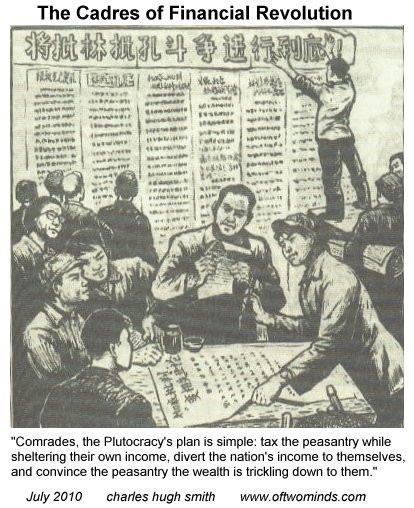
The con of the decade (Part II) involves sheltering the Power Elites' income while raising taxes on the debt-serfs to pay the interest owed the Power Elites.

The Con of the Decade (Part II) meshes neatly with the first Con of the Decade. Yesterday I described how the financial Plutocracy can transfer ownership of the Federal government's income stream via using the taxpayer's money to buy the debt that the taxpayers borrowed to bail out the Plutocracy.

In order for the con to work, however, the Power Elites and their politico toadies in Congress, the Treasury and the Fed must convince the peasantry that low tax rates on unearned income are not just "free market capitalism at its best" but that they are also "what the country needs to get moving again."

The first step of the con was successfully fobbed off on the peasantry in 2001: lower the taxes paid by the most productive peasants marginally while massively lowering the effective taxes paid by the financial Plutocracy.

One Year Later, No Sign of Improvement in America's Income Inequality Problem:

Income inequality has grown massively since 2000. According to Harvard Magazine, 66% of 2001-2007's income growth went to the top 1% of Americans, while the other 99% of the population got a measly 6% increase. How is this possible? One thing to consider is that in 2001, George W. Bush cut $1.3 trillion in taxes, and 32.6% of the cut went to the top 1%. Another factor is Bush's decision to increase the national debt from $5 trillion to $11 trillion. The combination of increased government spending and lower taxes helped the top 1% considerably.

The second part of the con is to mask much of the Power Elites' income streams behind tax shelters and other gaming-of-the-system so the advertised rate appears high to the peasantry but the effective rate paid on total income is much much lower.

The tax shelters are so numerous and so effective that it takes thousands of pages of tax codes and armies of toadies to pursue them all: family trusts, oil depletion allowances, tax-free bonds and of course special one-off tax breaks arranged by "captured" elected officials.

Step three is to convince the peasantry that $600 in unearned income (capital gains) should be taxed in the same way as $600 million. The entire key to the U.S. tax code is to tax earned income heavily but tax unearned income (the majority of the Plutocracy's income is of course unearned) not at all or very lightly.

In a system which rewarded productive work and provided disincentives to rampant speculation and fraud, the opposite would hold: unearned income would be taxed at much higher rates than earned income, which would be taxed lightly, especially at household incomes below $100,000.

If the goal were to encourage "investing" while reining in the sort of speculations which "earn" hedge fund managers $600 million each (no typo, that was the average of the top 10 hedgies' personal take of their funds gains), then all unearned income (interest, dividends, capital gains, rents from property, oil wells, etc.) up to $6,000 a year would be free--no tax. Unearned income between $6,000 and $60,000 would be taxed at 20%, roughly half the top rate for earned income. This would leave 95% of U.S. households properly encouraged to invest via low tax rates.

Above $60,000, then unearned income would be taxed the same as earned income, and above $1 million (the top 1/10 of 1% of households) then it would be taxed at 50%. Above $10 million, it would be taxed at 60%. Such a system would offer disincentives to the speculative hauls made by the top 1/10 of 1% while encouraging investing in the lower 99%.

Could such a system actually be passed into law and enforced by a captured, toady bureaucracy and Congress? Of course not. But it is still a worthy exercise to take apart the rationalizations being offered to justify rampant speculative looting, collusion, corruption and fraud.

The last step of the con is to raise taxes on the productive peasantry to provide the revenues needed to pay the Plutocracy its interest on Treasuries. If the "Bush tax cuts" are repealed, the actual effective rates paid on unearned income will remain half (20%) of the rates on earned income (wages, salaries, profits earned from small business, etc.) which are roughly 40% at higher income levels.

The financial Plutocracy will champion the need to rein in Federal debt, now that they have raised the debt via plundering the public coffers and extended ownership over that debt.

Now the con boils down to insuring the peasantry pay enough taxes to pay the interest on the Federal debt--interest which is sure to rise considerably. The 1% T-Bill rates were just part of the con to convince the peasantry that trillions of dollars could be borrowed "with no consequences." Those rates will steadily rise once the financial Power Elites own enough of the Treasury debt. Then the game plan will be to lock in handsome returns on long-term Treasuries, and command the toady politicos to support "austerity."

The austerity will not extend to the financial Elites, of course. That's the whole purpose of the con. "Some are more equal than others," indeed.

Labels: , ,

Friday, July 09, 2010

Denninger shows why the Stock Market is a fraud

and, coincidentally, why no regular small-time investor should still be in it...

via David Degraw:

Labels: , , ,

Saturday, June 26, 2010

The Housing Bubble Was Based On Fraud

Once again:

Recent filings by two Federal Home Loan Banks — in San Francisco and Seattle — offer an intriguing way to clear this high hurdle. Lawyers representing the banks, which bought mortgage securities, combed through the loan pools looking for discrepancies between actual loan characteristics and how they were pitched to investors.

You may not be shocked to learn that the analysis found significant differences between what the Home Loan Banks were told about these securities and what they were sold.

The rate of discrepancies in these pools is surprising. The lawsuits contend that half the loans were inaccurately described in disclosure materials filed with the Securities and Exchange Commission.

Half of them were fraudulent.

Half

There would have been no housing bubble without widespread fraud. None.

Virtually every major bank executive in the US should be indicted for fraud. The fact that there aren’t even serious investigations, let alone indictments, tells you everything you need to know. Everyone in the system knows it was all fraud, they knew it at the time, and that is exactly why there are no real investigations.

Labels: , , ,

Monday, May 24, 2010

the Upcoming (and current) Cap and Trade Scam

Since it's emergence into our consciousness, I've been suspicious of this Cap and Trade idea.

Washington's Blog:

Cap and Trade: A Gigantic Scam

As I pointed out in December:

James Hansen - the world's leading climate scientist fighting against global warming - told Amy Goodman this morning that cap and trade not only won't reduce emissions, it may actually increase them:

The problem is that the emissions just go someplace else. That’s what happened after Kyoto, and that’s what would happen again, if—as long as fossil fuels are the cheapest energy, they will be burned someplace. You know, the Europeans thought they actually reduced their emissions after Kyoto, but what happened was the products that had been made in their countries began to be made in other countries, which were burning the cheapest form of fossil fuel, so the total emissions actually increased...

See also this and this.

Environmental groups such as Friends of the Earth and Greenpeace are also against cap and trade (and see this and this), as is the head of California's cap and trade program for the EPA.

Hansen also told Goodman that (notwithstanding Paul Krugman's assertions) most economists say that cap and trade won't work:

I’ve talked with many economists, and the majority of them agree that the cap and trade with offsets is not the way to address the problem.

As I have previously pointed out:

  • The economists who invented cap-and-trade say that it won't work for global warming
  • European criminal investigators have determined that there is a tremendous amount of fraud occurring in the carbon trading market. Indeed, organized crime has largely taken over the European cap and trade market.
  • Former U.S. Undersecretary of Commerce for Economic Affairs Robert Shapiro says that the proposed cap and trade law "has no provisions to prevent insider trading by utilities and energy companies or a financial meltdown from speculators trading frantically in the permits and their derivatives."
  • Our bailout buddies over at Goldman Sachs, JP Morgan, Morgan Stanley, Citigroup and the other Wall Street behemoths are buying heavily into carbon trading (see this, this, this, this, this, this and this). As University of Maryland professor economics professor and former Chief Economist at the U.S. International Trade Commission Peter Morici writes:
    Obama must ensure that the banks use the trillions of dollars in federal bailout assistance to renegotiate mortgages and make new loans to worthy homebuyers and businesses. Obama must make certain that banks do not continue to squander federal largess by padding executive bonuses, acquiring other banks and pursuing new high-return, high-risk lines of businesses in merger activity, carbon trading and complex derivatives. Industry leaders like Citigroup have announced plans to move in those directions. Many of these bankers enjoyed influence in and contributed generously to the Obama campaign. Now it remains to be seen if a President Obama can stand up to these same bankers and persuade or compel them to act responsibly.
    In other words, the same companies that made billions off of derivatives and other scams and are now getting bailed out on your dime are going to make billions from carbon trading.
One the largest boosters for cap and trade invented credit default swaps - which were supposed to increase financial stability, but instead were a large part of the reason that the world economy crashed last year

Jeanne Roberts provides an update at environmental website Celsius:

The E.U. carbon emissions trading fraud is huge, but perhaps nothing compared to the potential for cheating that will become available in the United States once Waxman-Markey, or some similar scheme for reducing carbon emissions, emerges from the Senate to become law.

***

As Bloomberg notes, a carbon trading market organized around derivatives (sometimes known as credit default swaps, or CDS) is “open to manipulation,” in the words of billionaire hedge fund investor George Soros.

In fact, some old-school environmentalists see the whole carbon trading scheme as not a way to curb climate change, but merely a way to make the rich even richer at the expense of the rest of us. As Larry Lohmann, the founding member of the Durban Group for Climate Justice, says, “Dishonesty is rife throughout the carbon offset market.”

In January, investigators from Belgium said that in some E.U. countries, 90 percent of the market volume in carbon trading was based on criminal activities.

Labels: , , , ,

Friday, May 14, 2010

Obama, Congress and Bernanke did not save the world from a Great Depression

All they've done is delayed it. It's so sad.

Sorry, they simply did not. The baseline IMF forecast before the bailouts and before the stimulus bill tracks almost exactly what happened.

The bailouts were an actual net drag on the economy. Instead of cleaning up banks balance sheets, they allowed zombie banks to continue to exist, banks which are crippled when it comes to lending. In order to make sure these banks can pay down their bad debts, the Fed not only had to take on huge amounts of their paper at par when it was worth 20 cents at most, it has had to lend to them at concessionary rates, pay extra interest to them, and let them leverage that to make obscene profits from what lending they are doing (why did your credit card rate go up, that’s why?) and from trading on a captive market.

As best I can figure the stimulus was large enough to counteract the negative effect of the bailout.

The net, is a wash.

Furthermore, there were far, far more intelligent things which could have been done. The crisis was, as the tired phrase goes, also an opportunity to break the power of monied interests, so that ordinary Americans could prosper again and could reclaim their government. The stimulus was an opportunity to restructure the US economy to allow real, widespread growth in the future.

Both those opportunities were wasted, and they were wasted by Obama. TARP would not have passed without him, and once he was in power he could have demanded that Bernanke do as he commanded (break the banks) or step down, if Bernanke wouldn’t, he could have easily impeached him. The stimulus was his stimulus.

Obama, Congress, Bernanke, Geithner, Paulson—none of them saved anybody except the banks and the rich from apocalypse. I understand that partisan Democrats want to pretend Dems saved the world, but they did no such thing.

Labels: , ,

Monday, May 03, 2010

US economy seems to work better with high marginal tax rates

Ian Welsh:

Top Marginal Tax Rates
2010 May 2
2 Comments
by Ian Welsh

Because there seems to be some confusion, here’s a chart of the top marginal income tax rates. *

Top Marginal income tax rates


You’ll notice that as the rate has dropped, the economy has worked worse and worse for ordinary people. Correlation (though I believe strongly in causation in this case) but also it shows that high marginal progressive tax rates do not hurt the economy, contrary to what some think.

(*35% is still the top rate as of this writing).

Labels: , ,

Web Site Counters
Staples Coupons