Monday, June 28, 2010

Europe’s Fiscal Dystopia: The “New Austerity” Road to Neoserfdom

Michael Hudson at NewEconomicPerspectives.blogspot.com:

Somebody must take a loss on the economy's bad loans – and bankers want the economy to take the loss, to "save the financial system." From the financial sector's vantage point, the economy is to be managed to preserve bank liquidity, rather than the financial system run to serve the economy. Government social spending (on everything apart from bank bailouts and financial subsidies) and disposable personal income are to be cut back to keep the debt overhead from being written down. Corporate cash flow is to be used to pay creditors, not employ more labor and make long-term capital investment.

The economy is to be sacrificed to subsidize the fantasy that debts can be paid, if only banks can be "made whole" to begin lending again – that is, to resume loading the economy down with even more debt, causing yet more intrusive debt deflation.

This is not the familiar old 19th-century class war of industrial employers against labor, although that is part of what is happening. It is above all a war of the financial sector against the "real" economy: industry as well as labor.

The underlying reality is indeed that pensions cannot be paid – at least, not paid out of financial gains. For the past fifty years the Western economies have indulged the fantasy of paying retirees out of purely financial gains (M-M' as Marxists would put it), not out of an expanding economy (M-C-M', employing labor to produce more output). The myth was that finance would take the form of productive loans to increase capital formation and hiring. The reality is that finance takes the form of debt – and gambling. Its gains therefore were made from the economy at large. They were extractive, not productive. Wealth at the rentier top of the economic pyramid shrank the base below. So something has to give. The question is, what form will the "give" take? And who will do the giving – and be the recipients?

The Greek government has been unwilling to tax the rich. So labor must make up the fiscal gap, by permitting its socialist government to cut back pensions, health care, education and other social spending – all to bail out the financial sector from an exponential growth that is impossible to realize in practice. The economy is being sacrificed to an impossible dream. Yet instead of blaming the problem on the exponential growth in bank claims that cannot be paid, bank lobbyists – and the G-20 politicians dependent on their campaign funding – are promoting the myth that the problem is demographic: an aging population expecting Social Security and employer pensions. Instead of paying these, governments are being told to use their taxing and credit-creating power to bail out the financial sector's claims for payment.

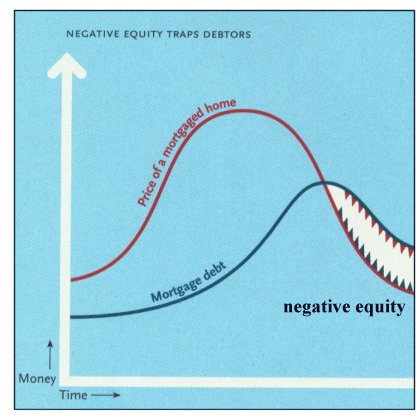
Latvia has been held out as the poster child for what the EU is recommending for Greece and the other PIIGS: Slashing public spending on education and health has reduced public-sector wages by 30 percent, and they are still falling. Property prices have fallen by 70 percent – and homeowners and their extended family of co-signers are liable for the negative equity, plunging them into a life of debt peonage if they do not take the hint and emigrate.

The bizarre pretense for government budget cutbacks in the face of a post-bubble economic downturn is that it will help to rebuild "confidence." It is as if fiscal self-destruction can instill confidence rather than prompting investors to flee the euro. The logic seems to be the familiar old class war, rolling back the clock to the hard-line tax philosophy of a bygone era – rolling back Social Security and public pensions, rolling back public spending on education and other basic needs, and above all, increasing unemployment to drive down wage levels. This was made explicit by Latvia's central bank – which EU central bankers hold up as a "model" of economic shrinkage for other countries to follow.

It is a self-destructive logic. Exacerbating the economic downturn will reduce tax revenues, making budget deficits even worse in a declining spiral. Latvia's experience shows that the response to economic shrinkage is emigration of skilled labor and capital flight. Europe's policy of planned economic shrinkage in fact controverts the prime assumption of political and economic textbooks: the axiom that voters act in their self-interest, and that economies choose to grow, not to destroy themselves. Today, European democracies – and even the Social Democratic, Socialist and labour Parties – are running for office on a fiscal and financial policy platform that opposes the interests of most voters, and even industry.

The explanation, of course, is that today's economic planning is not being done by elected representatives. Planning authority has been relinquished to the hands of "independent" central banks, which in turn act as the lobbyists for commercial banks selling their product – debt. From the central bank's vantage point, the "economic problem" is how to keep commercial banks and other financial institutions solvent in a post-bubble economy. How can they get paid for debts that are beyond the ability of many people to pay, in an environment of rising defaults?

The answer is that creditors can get paid only at the economy's expense. The remaining economic surplus must go to them, not to capital investment, employment or social spending.

This is the problem with the financial view. It is short-term – and predatory. Given a choice between operating the banks to promote the economy, or running the economy to benefit the banks, bankers always will choose the latter alternative. And so will the politicians they support.

Governments need huge sums to bail out the banks from their bad loans. But they cannot borrow more, because of the debt squeeze. So the bad-debt loss must be passed onto labor and industry. The cover story is that government bailouts will permit the banks to start lending again, to reflate the Bubble Economy's Ponzi-borrowing. But there is already too much negative equity and there is no leeway left to restart the bubble. Economies are all "loaned up." Real estate rents, corporate cash flow and public taxing power cannot support further borrowing – no matter how much wealth the government gives to banks. Asset prices have plunged into negative equity territory. Debt deflation is shrinking markets, corporate profits and cash flow. The Miracle of Compound Interest dynamic has culminated in defaults, reflecting the inability of debtors to sustain the exponential rise in carrying charges that "financial solvency" requires.

If the financial sector can be rescued only by cutting back social spending on Social Security, health care and education, bolstered by more privatization sell-offs, is it worth the price? To sacrifice the economy in this way would violate most peoples' social values of equity and fairness rooted deep in Enlightenment philosophy.

That is the political problem: How can bankers persuade voters to approve this under a democratic system? It is necessary to orchestrate and manage their perceptions. Their poverty must be portrayed as desirable – as a step toward future prosperity.

A half-century of failed IMF austerity plans imposed on hapless Third World debtors should have dispelled forever the idea that the way to prosperity is via austerity. The ground has been paved for this attitude by a generation of purging the academic curriculum of knowledge that there ever was an alternative economic philosophy to that sponsored by the rentier Counter-Enlightenment. Classical value and price theory reflected John Locke's labor theory of property: A person's wealth should be what he or she creates with their own labor and enterprise, not by insider dealing or special privilege.

This is why I say that Europe is dying. If its trajectory is not changed, the EU must succumb to a financial coup d'êtat rolling back the past three centuries of Enlightenment social philosophy. The question is whether a break-up is now the only way to recover its social democratic ideals from the banks that have taken over its central planning organs.

Labels: , , ,

Tuesday, March 03, 2009

The Language of Looting —Michael Hudson

Hudson dismantles the neoliberal corruption of the term "free market"—

more CounterPunch.org:

By MICHAEL HUDSON

"Banking shares began to plunge Friday morning after Senator Dodd, the Connecticut Democrat who is chairman of the banking committee, said in an interview with Bloomberg Television that he was concerned the government might end up nationalizing some lenders “at least for a short time.” Several other prominent policy makers – including Alan Greenspan, the former chairman of the Federal Reserve, and Senator Lindsey Graham of South Carolina – have echoed that view recently.”

--Eric Dash, “Growing Worry on Rescue Takes a Toll on Banks,” The New York Times, February 20, 2009

How is it that Alan Greenspan, free-market lobbyist for Wall Street, recently announced that he favored nationalization of America’s banks – and indeed, mainly the biggest and most powerful? Has the old disciple of Ayn Rand gone Red in the night? Surely not.

The answer is that the rhetoric of “free markets,” “nationalization” and even “socialism” (as in “socializing the losses”) has been turned into the language of deception to help the financial sector mobilize government power to support its own special privileges. Having undermined the economy at large, Wall Street’s public relations think tanks are now dismantling the language itself.

Exactly what does “a free market” mean? Is it what the classical economists advocated – a market free from monopoly power, business fraud, political insider dealing and special privileges for vested interests – a market protected by the rise in public regulation from the Sherman Anti-Trust law of 1890 to the Glass-Steagall Act and other New Deal legislation? Or is it a market free for predators to exploit victims without public regulation or economic policemen – the kind of free-for-all market that the Federal Reserve and Security and Exchange Commission (SEC) have created over the past decade or so? It seems incredible that people should accept today’s neoliberal idea of “market freedom” in the sense of neutering government watchdogs, Alan Greenspan-style, letting Angelo Mozilo at Countrywide, Hank Greenberg at AIG, Bernie Madoff, Citibank, Bear Stearns and Lehman Brothers loot without hindrance or sanction, plunge the economy into crisis and then use Treasury bailout money to pay the highest salaries and bonuses in U.S. history.

Terms that are the antithesis of “free market” also are being turned into the opposite of what they historically have meant. Take today’s discussions about nationalizing the banks. For over a century nationalization has meant public takeover of monopolies or other sectors to operate them in the public interest rather than leaving them so special interests. But when neoliberals use the word “nationalization” they mean a bailout, a government giveaway to the financial interests.

Doublethink and doubletalk with regard to “nationalizing” or “socializing” the banks and other sectors is a travesty of political and economic discussion from the 17th through mid-20th centuries. Society’s basic grammar of thought, the vocabulary to discuss political and economic topics, is being turned inside-out in an effort to ward off discussion of the policy solutions posed by the classical economists and political philosophers that made Western civilization “Western.”

Today’s clash of civilization is not really with the Orient; it is with our own past, with the Enlightenment itself and its evolution into classical political economy and Progressive Era social reforms aimed at freeing society from the surviving trammels of European feudalism. What we are seeing is propaganda designed to deceive, to distract attention from economic reality so as to promote the property and financial interests from whose predatory grasp classical economists set out to free the world. What is being attempted is nothing less than an attempt to destroy the intellectual and moral edifice of what took Western civilization eight centuries to develop, from the 12th century Schoolmen discussing Just Price through 19th and 20th century classical economic value theory.

Any idea of “socialism from above,” in the sense of “socializing the risk,” is old-fashioned oligarchy – kleptocratic statism from above. Real nationalization occurs when governments act in the public interest to take over private property. The 19th-century program to nationalize the land (it was the first plank of the Communist Manifesto) did not mean anything remotely like the government taking over estates, paying off their mortgages at public expense and then giving it back to the former landlords free and clear of encumbrances and taxes. It meant taking the land and its rental income into the public domain, and leasing it out at a user fee ranging from actual operating cost to a subsidized rate or even freely as in the case of streets and roads.

Nationalizing the banks along these lines would mean that the government would supply the nation’s credit needs. The Treasury would become the source of new money, replacing commercial bank credit. Presumably this credit would be lent out for economically and socially productive purposes, not merely to inflate asset prices while loading down households and business with debt as has occurred under today’s commercial bank lending policies.

How neoliberals falsify the West’s political history

The fact that today’s neoliberals claim to be the intellectual descendants of Adam Smith make it necessary to restore a more accurate historical perspective. Their concept of “free markets” is the antithesis of Smith’s. It is the opposite of that of the classical political economists down through John Stuart Mill, Karl Marx and the Progressive Era reforms that sought to create markets free of extractive rentier claims by special interests whose institutional power can be traced back to medieval Europe and its age of military conquest.

Economic writers from the 16th through 20th centuries recognized that free markets required government oversight to prevent monopoly pricing and other charges levied by special privilege. By contrast, today’s neoliberal ideologues are public relations advocates for vested interests to depict a “free market” is one free of government regulation, “free” of anti-trust protection, and even of protection against fraud, as evidenced by the SEC’s refusal to move against Madoff, Enron, Citibank et al.). The neoliberal ideal of free markets is thus basically that of a bank robber or embezzler, wishing for a world without police so as to be sufficiently free to siphon off other peoples’ money without constraint.

The Chicago Boys in Chile realized that markets free for predatory finance and insider privatization could only be imposed at gunpoint. These free-marketers closed down every economics department in Chile, every social science department outside of the Catholic University where the Chicago Boys held sway. Operation Condor arrested, exiled or murdered tens of thousands of academics, intellectuals, labor leaders and artists. Only by totalitarian control over the academic curriculum and public media backed by an active secret police and army could “free markets” neoliberal style be imposed. The resulting privatization at gunpoint became an exercise in what Marx called “primitive accumulation” – seizure of the public domain by political elites backed by force. It is a free market William-the-Conqueror or Yeltsin-kleptocrat style, with property parceled out to the companions of the political or military leader.

All this was just the opposite of the kind of free markets that Adam Smith had in mind when he warned that businessmen rarely get together but to plot ways to fix markets to their advantage. This is not a problem that troubled Mr. Greenspan or the editorial writers of the New York Times and Washington Post. There really is no kinship between their neoliberal ideals and those of the Enlightenment political philosophers. For them to promote an idea of free markets as ones “free” for political insiders to pry away the public domain for themselves is to lower an intellectual Iron Curtain on the history of economic thought.

[. . .]


Labels: , , ,

Saturday, November 08, 2008

Another Paradigm for the Debt Economy

This post dove-tails nicely into the following one I just posted about a typical couple being washed out of the middle class by a tsunami of debt...

charles hugh smith in of two minds.com:

The Company Store, Debt and Serfdom

Way back in May 2006 I wrote about Michael Hudson's work on The New Road to Serfdom: A Negative-Equity Mortgage.
I am now thinking there's another analog to our entire economy: the company store. I actually lived in one of the last plantation "company towns" in Hawaii, and though Dole Pineapple didn't operate a "company store" in 1969, earlier plantations (and coal mining towns, etc.) did--and the set-up was sweet indeed.

Much like a serf renting/sharecropping land owned by a manor-house or nobility, the plantation worker needed to borrow money to buy food and other necessities at the company store, which just happened to operate as a monopoly and just happened to charge skyhigh prices. (The serf needed to borrow seed for the next planting, and money to buy food for the family in between harvests.) The rate of interest paid by the serf/worker was always much higher than market rates--another monopoly capital (and highly profitable) feature of the set-up.

The system's most pernicious feature: the worker/serf never escaped debt. Indeed, the system was constructed to increase the debt to the point it could never be paid off, insuring a lifetime of profitable servitude to the nobility/corporation.

Now the Powers That Be, as embodied in this Republican Administration and its lackeys/minions in both parties, have perfected an entire economy based on this "Company Store"/manor-house model.

As Jesse over at Jesse's Cafe Americain noted in The Safety and Immediacy of Liquid Assets in a Deleveraging Panic:

This is a critical point, and little debated or understood as it is emotionally charged with words like 'socialism.' Most do not understand the fractional reserve banking system, but it seems more official, more palatable, to give them billions, enormous sums, and to give the public as little as possible for fear of debasing the value of work and the currency.

Paulson and Bernanke both view the economy as an adjunct to the financial system so from their perspective the choice is obvious.

The power of the serf/company store model is only truly revealed by examining not just negative-equity home mortgages but negative-equity auto loans, credit card debt, etc. How about the serf who bought an SUV with no money/low money down? How much is his auto loan, and how much is the gashog SUV worth now? Far less than what he owes; he has hugely negative equity in not just his house but in his vehicles and indeed, in everything he "owns" which was purchased on credit.

And how about the clothing and TVs and other toys purchased on a zero-interest "teaser rate" credit card? How much is all that used stuff worth? Ten cents on the dollar? And what happens when the debt serf--who bless his naive little heart, actually believes the illusion that he is "middle class"--har har har--is late one payment? Bam! That zero-interest balance is suddenly being charged 23% interest.

Oh, and the late fee is $50. And one other thing--all the other credit cards he "owns" will also pop to 23% interest because, well, they can raise the rates whenever they want--but the official excuse is he's now a "credit risk."

As if he was ever not a credit risk?

Just like the worker and the company store, the credit card debt actually rises regardless of how much the worker pays. It's a beautiful lifetime system for serfdom/poverty and endless rentier profits for banks. Thus we read story after story in which a credit card balance of $1,500 balloons toover $5,000 as interest rates are jacked to 24% and huge late fees and overdraft fees are levied.

As Merle Travis wrote about the company store:

You load sixteen tons . . . what do you get?
Another day older and deeper in debt
Saint Peter don't you call me 'cause I can't go
I owe my soul to the company store

Exactly what is the difference between the serf or the plantation/mine worker and today's debt-enslaved "middle-class" peasant?

A key con of the Company Store model circa 2001-2007 was that extracting money from your home equity was essentially identical to withdrawing savings. This conceit was enabled by absurdly low interest rates and essentially qualification-free money; if equity is like savings, then withdrawing it--at almost no extra increase in monthly mortgage payments!--was just like taking money out of a savings account.

Except for one little tiny feature of the equity extraction--it was debt, not savings.

Another key con was the illusion that this debt was essentially risk-free. With house prices rising, and loans getting ever cheaper, then only a fool would forego the chance to extract and spend the "savings" of rising equity.

As often noted here, real wages (as measured by purchasing power or adjusted for inflation) has been stagnant since the mid-1970s. Like the indentured serf, the average "middle class" (sounds so much better than debt-serf, doesn't it?) wage earner saw a seemingly golden path out of stagnating purchasing power: borrow more for a lower monthly payment.

But alas, the teaser rates on the adjustable-rate mortgage and the credit cards expired, and now the real costs are being levied.

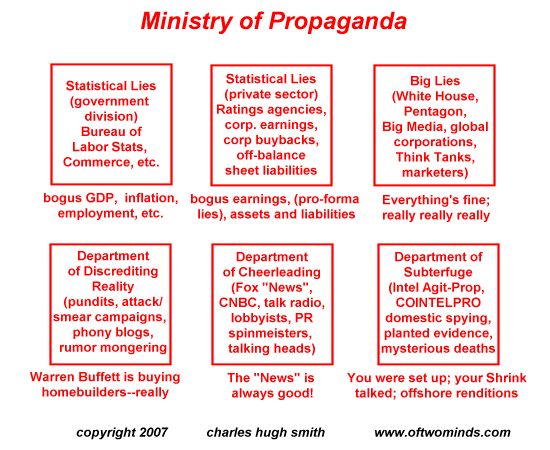
Many readers write to remind me that "nobody forced anyone to take out the loan," and that is true. We all have so-called free will. But it is naive to focus on free will (which does not operate in a vacuum but in a cultural and historical context) and ignore the incredibly concentrated power of the Ministry of Propaganda. I have illustrated the rough inter-connected structure of the Ministry in this helpful little diagram:

Most astonishingly, the Ministry has succeeded in diverting the nation's attention from the Company store/debt-serf realities to a bogus "debate" over "socialism" and "capitalism." As Michael Hudson has pointed out, the rentier class which owns the mortgages, loans and credit card debt is not capitalist at all; it is essentially medieval in structure. It takes no risks, creates no innovations, invests no capital in new enterprises or indeed, performs any classical capitalist functions at all.

It simply indebts the serfs, convinces them via doublespeak, propagands and phony statistics that they are still gloriously "middle class" (that is, obscuring or reifying their true nature as mere miserable debt serfs) and then sits back and collects the interest and profits which the debt serfs will be struggling to pay until their last breath.

Nice set-up. No criminal extortion scheme could be more effective or venal.

We should note that the Democratic members of the Powers That Be all voted for the banker-bailout, knowing full well that the bankers/company store could have been allowed to go bankrupt and the $700 billion could have spent--if it was to be spent at all--on education, rebuilding bridges, transmission lines, and other desperately needed infrastructure projects.

But this could not be allowed to happen. Why? Because money spent on infrastructure flows directly into workers' pockets, removing the intermediary debt which is the entire key to the Company Store model. The Paulson bailout's key feature is that it does not put a single dollar in the pocket of a mere serf/worker--every dollar goes to save the current system, which is based on the serf borrowing money constantly at ever higher interest rates.

[. . .]

Labels: , , ,

Thursday, September 25, 2008

Henry Paulson and the New Yazoo Land Scandal

Counterpunch.org:

A Cautionary Tale About Politicos and Financiers

By MICHAEL HUDSON

Present discussions of the mortgage mess are lapsing into an unreal world. Advocates of the $700 bailout are now rounding up a choir of voices to proclaim that the problem is simply a lack of liquidity. This kind of problem, we are told, can be solved “cleanly” (that is, with no Congressional add-ons to protect anyone except the major Bush Administration campaign contributors) by the Federal reserve “pumping credit” into the system by buying securities that have no market when “liquidity dries up.”

What is wrong with this picture? The reality is that there is much too much liquidity in the system. That is why the yield on U.S. Treasury bills has fallen to just 0.16 percent – just one sixth of one percent! This is what happens when there is a flight to safety. By liquid investors. Many of which are now fleeing abroad, as shown by the dollar’s 3% plunge against the euro yesterday (Monday, Sept. 22).

The question that the media avoid asking is what people are trying to be safe from? The answer should be obvious to anyone who has been reading about the junk mortgage problem. Investors – especially in Germany, whose banks have been badly burned – are seeking to be safe from fraud and misrepresentation. U.S. banks and firms have lost the trust of large institutional investors here and abroad, because of year after year of misrepresentation as to the quality of the mortgages and other debts they were selling. This is Enron-style accounting with an exclamation point – fraud on an unparalleled scale.

How many tears should we shed for the victims? The Wall Street firms and banks stuck with junk mortgages are in the position of fences who believed that they had bought bona fide stolen money (“fallen off a truck”) from a bank-robbing gang, only to find that the bills they bought are counterfeit – with their serial numbers registered with the T-men to make spending the loot difficult. Their problem now is how to get this junk off their hands. The answer is to strike a deal with the T-men themselves, who helped them rob the bank in the first place.

There is a long pedigree for this kind of behavior. And it always seems to involve a partnership between kleptocratic insiders and the Treasury. Today’s twist is that the banksters have lined up complicit accomplices from the accounting industry and bond-rating companies as well. The gang’s all here.

In view of the mass media these days calling Henry Paulson the most powerful Treasury Secretary since Alexander Hamilton, I think it is relevant to look at two leading acts of Mr. Hamilton that represent remarkable precursors of Mr. Paulson’s present $800 billion “cash for trash” deal with the Bush Administration’s major Wall Street campaign contributors.

The two most appropriate parallels are the government’s redemption of “continentals” – paper money issued by the colonies during the Revolutionary War – and the Yazoo land grants. During the Revolution, states had issued paper currency to pay the troops and meet other basic expenses. These paper notes had depreciated, hence the term “not worth a continental” (not least because of large-scale counterfeiting by the British to cause economic disruption here). In the crisis, men with hard cash went around buying continentals at a great discount. In one of the most notorious and debated acts of the Constitutional Convention, the new United States Government redeemed this depreciated paper currency at par.

It was like the Treasury today buying junk mortgages at face value. But it is in the ensuing Yazoo scandal that we find a perfect combination of financial and real estate fraud on a magnitude that helped establish some of America’s great founding fortunes, creating dynastic wealth that has survived down to the present day.

The Yazoo land fraud in Bourbon County, Georgia is one of the most notorious incidents of our early Republic. In January 1795 the state sold 35 million acres to four land companies for less than 1½¢ an acre. This was the result of bribery arranged by James Wilson – whom George Washington subsequently rewarded by naming him to the Supreme Court. (Moral: Crime pays.) To add insult to injury, the state was paid in depreciated currency, the “continentals.” So great was the outcry that a new state legislature was elected, and revoked the sale in February 1796, accusing its beneficiaries of “improper influence.”

But a month before this new legislature was convened, one of the companies (the Georgia Mississippi Land Company) sold over 10 million acres, nominally at 10¢ cents an acre, to the New England Mississippi Land Company, which was quickly organized for just this purpose by some eminent Bostonian speculators, headed by William Wetmore. Only part of the money actually was paid in cash, and the transaction was largely a paper one. The company quickly hired agents to began selling shares to the public. Widespread speculation ensued in many states, each new investor becoming a partisan urging the national and state governments go along with the original fraud.

New fraudsters jumped on board. Patrick Henry (“Give me liberty, or give me death”) headed up the Virginia Yazoo Company, which made a deal with Virginia Governor Telfair to buy twenty million acres of land at a penny an acre – paid for with the worthless continentals. The public was furious, but the “free marketers” of the day asked, what was wealth, anyway, but a reward for risk-taking.

After the Yazoo land was turned over to the federal government in 1803, a series of Congressional investigations reported that the Boston company actually had paid little if any of the purchase price. (This is now called debt leveraging.) But the company sued, and lobbied Congress for over a decade to get compensation for its paper losses – that is, its lost opportunity to profit from the transaction. In 1814, in the turbulent aftermath of the War of 1812, Congress passed an indemnification act compensating them and other Yazoo investors with $8 million of public funds.

This settlement helped establish a fateful legal precedent known as the doctrine of innocent purchasers possessing certain vested rights. The ruling was steered through the Supreme Court by James Wilson, who in 1782 (along with Robert Morris as the bank’s president, and Gouverneur Morris) had obtained from Pennsylvania’s legislature a charter for the Bank of North America on terms similar to those of the Yazoo land claim.

As Charles Beard has pointed out in his classic Economic Interpretation of the Constitution, James Wilson, the two Morrises, and two other bank directors (Thomas Fitzsimmons and George Clymer) acted as delegates to the Constitutional Convention, where they shaped America's laws so as to facilitate their de-accessioning of public property and obtained special rights and charters for banks and other monopolies. (The word “privatization” would take nearly two centuries to enter the lexicon.) After the Bank of North America was so mismanaged that a money panic ensued, Pennsylvania revoked it's charter. Wilson sued, arguing “that the original act was a grant of a VESTED RIGHT. That the charter could not be repealed without ‘IMPAIRING VESTED RIGHTS, and the rights of innocent parties.’ The legislature yielded, and in 1787 it reincorporated the bank. Thus originated the clause that Wilson had inserted in the present constitution forbidding any state to pass legislation impairing the obligation of a contract. And out of it has come Supreme Court decisions that have given this country the blackest record of validated land frauds and bribery known in history,” for it blocked state legislatures and Congress from undoing the results of overt bribery. (The story is told in Thomas L. Brunk, American Lordships, or A Brief Insight into the Suppressed History of Land Sharks and Their Control Over Government and Industry (Sioux City, Iowa, 1927, p. 84).

The Supreme Court had ruled (in response to John Marshall’s pleading the Fairfax land-fraud case in Virginia) that what mattered was not the methods used to obtain a grant or contract, but the fact that innocent purchasers would be injured by repealing such contracts once they had been entered into (Chandler 1945:74,390). Even outright frauds were held irrevocable by subsequent legislation, on the ground that once a business claim was sold to an innocent purchaser, undoing the deal would be unfair. The unwitting buyer would be left holding the proverbial bag. Myers (1936:217) finds this to be “the first of a long line of court decisions validating grants and franchises of all kinds secured by bribery and fraud.”

The new doctrine provided a motive for privatizers to cash in quickly by selling out shares of fraudulent transactions to speculators and other buyers, who could then ask the state to “make them whole” for having injured them in revoking their wrongful purchase! Likewise today, polluters and real-estate holders are suing the government to be compensated for public laws that prevent them from making money by violating ecological and other real-estate regulations. Their demand is to be made whole for gains they allegedly would have been able to make had such public laws not been passed!

The “innocent purchaser” and “vested interest” doctrines made it hard to undo fraud, if only because the alternative was to restore the misappropriated asset from the stock-buying public to the state. The Supreme Court ruled it preferable to let the first thief legitimize his fraud, leaving the “innocent buyers” in possession of the stolen property. Possession became, ipso facto, nine-tenths of the law. The moral of this story was that once you obtain public assets, even through bribery, it is yours, at least if you make the transaction complicated enough and involve enough “innocent parties” to make any restoration of the status quo ante hopelessly complicated.

The Yazoo incident is only exceptional for its size and the fact that it became a precedent for future practices. In 1835 the Senate Committee on Lands reported: “The first step necessary to the success of every scheme of speculation in the public lands, is to corrupt the land officers, by a secret understanding between the parties that they are to receive a certain portion of the profits.” Sixty years later, in 1895, Iowa's Governor William Larrabee wrote on how the system had been perfected (largely by the railroad robber barons): “Outright bribery is probably the means least often employed by corporations to carry their measures. ... It is the policy of the political corruption committees of corporations to ascertain the weakness and wants of every man whose services they are likely to need, and to attack him, if his surrender should be essential to their victory, at his weakest point. Men with political ambition are encouraged to aspire to preferment, and are assured of corporate support to bring it about. Briefless lawyers are promised corporate business or salaried attorneyships. Those in financial straits are accommodated with loans. Vain men are flattered and given newspaper notoriety. Others are given passes for their families and their friends. Shippers are given advantage in rates over their competitors. The idea is that every legislator shall receive for is vote and influence some compensation which combines the maximum of desirability to him with the minimum of violence to his self-respect. … The lobby which represents the railroad companies at legislative sessions is usually the largest, the most sagacious and the most unscrupulous of all. … Telegrams pour in upon the unsuspecting members. … Another powerful reinforcement of the railroad lobby is not infrequently a subsidized press and its correspondents.”

Gustavus Myers’ History of the Great American Fortunes (1936, pp. 218ff.) gives the details of this and other frauds that have shaped American history. The moral is that great gifts to insiders have effects that will last centuries. That is what is being threatened today with Mr. Paulson’s “clean” giveaway to his Wall Street clients.

The moral is that there is a great danger in having a Treasury Secretary represent insider financial interests rather than the national interest.

Michael Hudson is a former Wall Street economist specializing in the balance of payments and real estate at the Chase Manhattan Bank (now JPMorgan Chase & Co.), Arthur Anderson, and later at the Hudson Institute (no relation). In 1990 he helped established the world’s first sovereign debt fund for Scudder Stevens & Clark. Dr. Hudson was Dennis Kucinich’s Chief Economic Advisor in the recent Democratic primary presidential campaign, and has advised the U.S., Canadian, Mexican and Latvian governments, as well as the United Nations Institute for Training and Research (UNITAR). A Distinguished Research Professor at University of Missouri, Kansas City (UMKC), he is the author of many books, including Super Imperialism: The Economic Strategy of American Empire (new ed., Pluto Press, 2002) He can be reached via his website, mh@michael-hudson.com

Labels: , , , , , , , ,

Friday, September 05, 2008

Michael Hudson explains to Mike Whitney how the economy works

The end of a long Online Journal interview:

MW: The housing market is freefalling, setting new records every day for foreclosures, inventory, and declining prices. The banking system is in even worse shape, undercapitalized and buried under a mountain of downgraded assets. There seems to be growing consensus that these problems are not just part of a normal economic downturn, but the direct result of the Fed’s monetary policies. Are we seeing the collapse of the Central banking model as a way of regulating the markets? Do you think the present crisis will strengthen the existing system or make it easier for the American people to assert greater control over monetary policy?

Michael Hudson: What do you mean “failure”? Your perspective is from the bottom looking up. But the financial model has been a great success from the vantage point of the top of the economic pyramid looking down? The economy has polarized to the point where the wealthiest 10 percent now own 85 percent of the nation’s wealth. Never before have the bottom 90 percent been so highly indebted, so dependent on the wealthy. From their point of view, their power has exceeded that of any time in which economic statistics have been kept.

You have to realize that what they’re trying to do is to roll back the Enlightenment, roll back the moral philosophy and social values of classical political economy and its culmination in Progressive Era legislation, as well as the New Deal institutions. They’re not trying to make the economy more equal, and they’re not trying to share power. Their greed is (as Aristotle noted) infinite. So what you find to be a violation of traditional values is a re-assertion of pre-industrial, feudal values. The economy is being set back on the road to debt peonage. The Road to Serfdom is not government sponsorship of economic progress and rising living standards, it’s the dismantling of government, the dissolution of regulatory agencies, to create a new feudal-type elite.

The former Soviet Union provides a model of what the neoliberals would like to create. Not only in Russia but also in the Baltic States and other former Soviet republics, they created local kleptocracies, Pinochet-style. In Russia, the kleptocrats founded an explicitly Pinochetista party, the Party of Right Forces (“Right” as in right wing).

In order for the American people or any other people to assert greater control over monetary policy, they need to have a doctrine of just what a good monetary policy would be. Early in the 19th century, the followers of St. Simon in France began to develop such a policy. By the end of that century, Central Europe implemented this policy, mobilizing the banking and financial system to promote industrialization, in consultation with the government (and catalyzed by military and naval spending, to be sure). But all this has disappeared from the history of economic thought, which no longer is even taught to economics students. The Chicago Boys have succeeded in censoring any alternative to their free-market rationalization of asset stripping and economic polarization.

My own model would be to make central banks part of the Treasury, not simply the board of directors of the rapacious commercial banking system. You mentioned Henry Liu’s writings earlier, and I think he has come to the same conclusion in his Asia Times articles.

MW: Do you see the Federal Reserve as an economic organization designed primarily to maintain order in the markets via interest rates and regulation or a political institution whose objectives are to impose an American-dominated model of capitalism on the rest of the world?

Michael Hudson: Surely, you jest! The Fed has turned “maintaining order” into a euphemism for consolidating power by the financial sector and the FIRE sector generally (Finance, Insurance and Real Estate) over the “real” economy of production and consumption. Its leaders see their job as being to act on behalf of the commercial banking system to enable it to make money off the rest of the economy. It acts as the Board of Directors to fight regulation, to support Wall Street, to block any revival of anti-usury laws, to promote “free markets” almost indistinguishable from outright financial fraud, to decriminalize bad behavior -- and most of all to inflate the price of property relative to the wages of labor and even relative to the profits of industry.

The Fed’s job is not really to impose the Washington Consensus on the rest of the world. That’s the job of the World Bank and IMF, coordinated via the Treasury (viz. Robert Rubin under Clinton most notoriously) and AID, along with the covert actions of the CIA and the National Endowment for Democracy. You don’t need monetary policy to do this -- only massive bribery. Only call it “lobbying” and the promotion of democratic values -- values to fight government power to regulate or control finance across the world. Financial power is inherently cosmopolitan and, as such, antagonistic to the power of national governments.

The Fed and other government agencies, Wall Street and the rest of the economy form part of an overall system. Each agency must be viewed in the context of this system and its dynamics -- and these dynamics are polarizing, above all from financial causes. So we are back to the “magic of compound interest,” now expanded to include “free” credit creation and arbitraging.

The problem is that none of this appears in the academic curriculum. And the silence of the major media to address it or even to acknowledge it means that it is invisible except to the beneficiaries who are running the system.

Labels: , , ,

Web Site Counters
Staples Coupons