Tuesday, October 06, 2009

Study: Bush administration blocked efforts to prevent housing crisis

Yeah, I remember reading about this last year...

Raw Story:
By Daniel Tencer
Tuesday, October 6th, 2009 -- 10:42 am

Federal regulators in the Bush administration blocked attempts by state governments to prevent predatory lending practices that resulted in the financial crisis now stalking the American economy, a new study from the University of North Carolina says.

In 2004, the Office of the Currency Comptroller, an obscure regulatory agency tasked with ensuring the fiscal soundness of America's banks, invoked an 1863 law to give itself the power to override state laws against predatory lending. The OCC told states they could not enforce predatory-lending laws, and all banks would be subject only to less-strict federal laws.

Now, a research paper (PDF) from UNC-Chapel Hill's Center for Community Capital shows that those anti-predatory lending laws had actually worked. States that had stricter regulations on issuing mortgages were found to have fewer foreclosures.

"We believe that these findings are remarkable, since they suggest an important and yet unexplored link between [anti-predatory lending laws] and foreclosures," the study's authors state.

The study may be the first scientific evidence to back up claims made by many critics that the Bush administration and earlier administrations allowed last year's financial crisis to happen by not enforcing common-sense regulations on lenders.

Last year, seven months before the collapse of Lehman Brothers and the ensuing government banking bailout, then-New York Governor Eliot Spitzer wrote a Washington Post column in which he described how the Bush administration blocked states' efforts to prevent a crisis in the mortgage industry.

Spitzer wrote:

Predatory lending was widely understood to present a looming national crisis. This threat was so clear that as New York attorney general, I joined with colleagues in the other 49 states in attempting to fill the void left by the federal government. Individually, and together, state attorneys general of both parties brought litigation or entered into settlements with many subprime lenders that were engaged in predatory lending practices. Several state legislatures, including New York's, enacted laws aimed at curbing such practices.

What did the Bush administration do in response? Did it reverse course and decide to take action to halt this burgeoning scourge? As Americans are now painfully aware, with hundreds of thousands of homeowners facing foreclosure and our markets reeling, the answer is a resounding no.

Not only did the Bush administration do nothing to protect consumers, it embarked on an aggressive and unprecedented campaign to prevent states from protecting their residents from the very problems to which the federal government was turning a blind eye.

Spitzer's Post column ran a month before the New York Times reported that federal authorities were investigating Spitzer as a patron of high-end hookers, ending his political career and long-running crusade against corporate malfeasance. Some observers, including investigative reporter Greg Palast, say this was not a coincidence.

The UNC study "is a perfect reminder, as Congress and the administration tackle financial regulatory reform, that not all regulations are onerous, anti-business, and aimed at choking off financial innovation," writes Mary Kane at the Washington Independent. "And it’s more evidence that borrowers buying beyond their means weren’t the only only players in the sub-prime mess."

Labels: , ,

Sunday, May 10, 2009

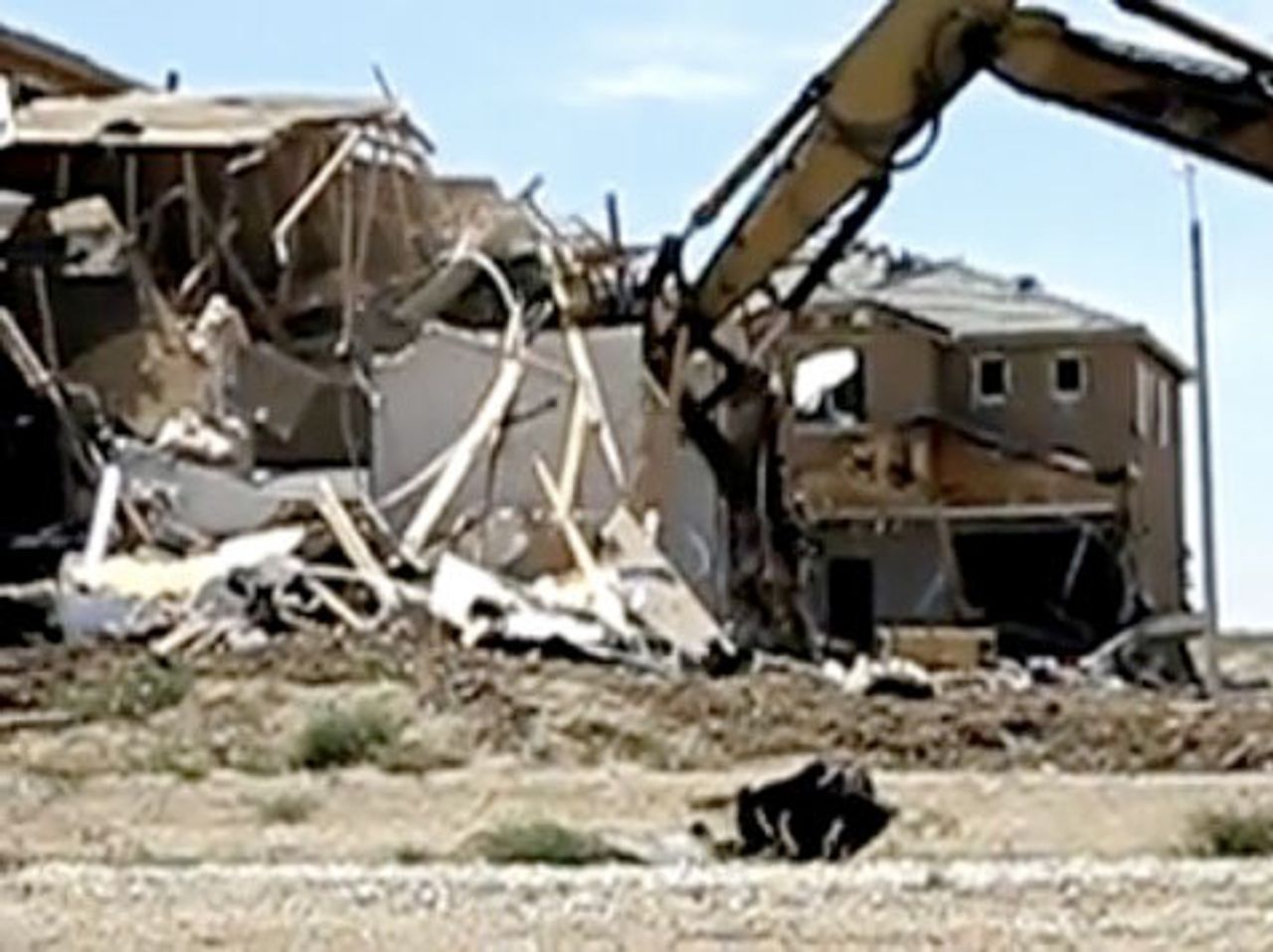
Texas bank demolishes high end subdivision in California

World Socialist Web Site:

Bank demolishes new Southern California homes, citing low profit-potential

By Shannon Jones
8 May 2009

Home razingThe bank-ordered razing of a new housing development in Victorville, California, highlights the bankruptcy of the profit system under conditions of the deepening recession and growing social misery.

Texas-based Guaranty Bank has decided to have 16 homes destroyed in the desert community because the estimated $1 million cost to complete them was more than it could make selling them. Four of the luxury homes, priced in the $280,000-350,000 range, were already finished, and the others were in various stages of completion. The estimated cost of the demolition was over $100,000.

According to a report in the Los Angeles Times, the median new home price in San Bernardino County, where Victorville is located, is $160,000, down 43 percent in one year. Banks foreclosed on 236,000 homes in California in 2008.

A video of the demolition was broadcast on You Tube. According to the report, the bank has another 20 California homes slated for demolition in Temecula, about an hour and a half to the south.

Work began on the development in 2007, before the full impact of the bursting housing bubble hit Southern California. Construction stopped last summer, and the bank took back the property from the developer in December 2008 through foreclosure.

According to a report in the May 7 Wall Street Journal, thousands of construction projects across the United States lie idle. It cites New York-based Real Analytics Inc., “which estimated that there were 3,929 distressed commercial properties across the US as of March 31—a 55 percent jump since Dec. 31, 2008.”

According to one research firm, some 250 residential developments have been halted in California, comprising over 9,300 homes.

The Journal points to environmental and health concerns over the growing number of abandoned or idle construction sites. In the case of the project demolished in California, Guaranty Bank justified the action on the grounds that it wanted to create a “safe environment” by preventing squatters from taking over the homes.

A spokesman for Guaranty Bank told the San Jose Mercury News, “The current economic environment requires difficult decisions be made by the government, by banks and by individuals. We made the difficult decision to return the site to a safe, clean and undeveloped state keeping in mind the best interests of the community and our shareholders.” The bank indicated that once the demolition is completed the property will be put back on the market.

One Victorville city official defended the bank’s decision, saying, “It just didn’t pencil out for them. They’d have to spend a lot of money to turn around and sell the houses. They just made a financial decision to demolish them.”

The demolition of the houses shocked many. Ron Willemsen, the president of Intravaia Rock and Sand, the company that handled the demolition, told the LA Times, “It’s a waste of a lot of resources and perfectly good construction.”

The federal Office of Thrift Supervision recently cited Guaranty Financial Group, the parent of Guaranty Bank, for “unsafe and unsound banking practices.” It faces a May 21 deadline to improve its capital ratios or face merger or liquidation. Guaranty has loaned large amounts to home developers and has foreclosed on many projects. Regulators are putting pressure on the bank to come up with a plan to dispose of foreclosed properties.

The decision of Guaranty Bank to destroy brand new homes based on economic calculation points to the destructive irrationality of an economic system based on private ownership and production for profit.

It calls to mind the events of the 1930s, when, in the midst of the Depression, the Roosevelt administration had farmers plough under cotton crops, leave fields fallow and slaughter hundreds of thousands of hogs, to artificially raise agricultural prices by decreasing supplies. This under conditions where millions of people were malnourished.

As in the Great Depression, the products of labor are being destroyed as need mounts. Currently there are some 4 million vacant homes in the US, 3 percent of the total housing stock. Yet the number of so-called economic homeless is on the rise across the United States.

A report titled “The New Homeless” on allgov.com notes, “Tent cities and shelters from California to Massachusetts report growing demand from the newly homeless.” The city of Sacramento, California, recently closed down a tent city after it attracted national media attention. In January, the National Alliance to End Homelessness predicted the economic crisis would force 1.5 million people into homelessness over the next two years.

Labels: , , ,

Saturday, February 23, 2008

12 Steps to US Financial Meltdown

(and eight reasons why the Fed cannot head it off...)


Via: the Cryptogon:


Business Spectator / Financial Times:

Martin Wolf, Financial Times

Twelve steps to meltdown

“I would tell audiences that we were facing not a bubble but a froth – lots of small, local bubbles that never grew to a scale that could threaten the health of the overall economy.” So wrote Alan Greenspan in The Age of Turbulence.

That used to be Mr Greenspan’s view of the US housing bubble. He was wrong, alas. So how bad might this downturn get? To answer this question we should ask a true bear. My favourite one is Nouriel Roubini of New York University’s Stern School of Business, founder of RGE Monitor.

Recently, Professor Roubini’s scenarios have been dire enough to make the flesh creep. But his thinking deserves to be taken seriously. He first predicted a US recession in July 2006. At that time, his view was extremely controversial. It is so no longer. Now he states that there is “a rising probability of a ‘catastrophic’ financial and economic outcome”. The characteristics of this scenario are, he argues: “A vicious circle where a deep recession makes the financial losses more severe and where, in turn, large and growing financial losses and a financial meltdown make the recession even more severe.”

Prof Roubini is even fonder of lists than I am. Here are his 12 – yes, 12 – steps to financial disaster.

Step one is the worst housing recession in US history. House prices will, he says, fall by 20 to 30 per cent from their peak, which would wipe out between $4,000 billion and $6,000 billion in household wealth. Ten million households will end up with negative equity and so with a huge incentive to put the house keys in the post and depart for greener fields. Many more home-builders will be bankrupted.

Step two would be further losses, beyond the $250 billion-$300 billion now estimated, for sub-prime mortgages. About 60 per cent of all mortgage origination between 2005 and 2007 had “reckless or toxic features”, argues Roubini. Goldman Sachs estimates mortgage losses at $400 billion. But if home prices fell by more than 20 per cent, losses would be bigger. That would further impair the banks’ ability to offer credit.

Step three would be big losses on unsecured consumer debt: credit cards, auto loans, student loans and so forth. The “credit crunch” would then spread from mortgages to a wide range of consumer credit.

Step four would be the downgrading of the monoline insurers, which do not deserve the AAA rating on which their business depends. A further $150 billion writedown of asset-backed securities would then ensue.

Step five would be the meltdown of the commercial property market, while step six would be bankruptcy of a large regional or national bank.

Step seven would be big losses on reckless leveraged buy-outs. Hundreds of billions of dollars of such loans are now stuck on the balance sheets of financial institutions.

Step eight would be a wave of corporate defaults. On average, US companies are in decent shape, but a “fat tail” of companies has low profitability and heavy debt. Such defaults would spread losses in “credit default swaps”, which insure such debt. The losses could be $250 billion. Some insurers might go bankrupt.

Step nine would be a meltdown in the “shadow financial system”. Dealing with the distress of hedge funds, special investment vehicles and so forth will be made more difficult by the fact that they have no direct access to lending from central banks.

Step 10 would be a further collapse in stock prices. Failures of hedge funds, margin calls and shorting could lead to cascading falls in prices.

Step 11 would be a drying-up of liquidity in a range of financial markets, including interbank and money markets. Behind this would be a jump in concerns about solvency.

Step 12 would be “a vicious circle of losses, capital reduction, credit contraction, forced liquidation and fire sales of assets at below fundamental prices”.

These, then, are 12 steps to meltdown. In all, argues Roubini: “Total losses in the financial system will add up to more than $1,000 billion and the economic recession will become deeper more protracted and severe.” This, he suggests, is the “nightmare scenario” keeping Ben Bernanke and colleagues at the US Federal Reserve awake. It explains why, having failed to appreciate the dangers for so long, the Fed has lowered rates by 200 basis points this year. This is insurance against a financial meltdown.

Is this kind of scenario at least plausible? It is. Furthermore, we can be confident that it would, if it came to pass, end all stories about “decoupling”. If it lasts six quarters, as Roubini warns, offsetting policy action in the rest of the world would be too little, too late.

Can the Fed head this danger off? In a subsequent piece, Roubini gives eight reasons why it cannot. (He really loves lists!) These are, in brief: US monetary easing is constrained by risks to the dollar and inflation; aggressive easing deals only with illiquidity, not insolvency; the monoline insurers will lose their credit ratings, with dire consequences; overall losses will be too large for sovereign wealth funds to deal with; public intervention is too small to stabilise housing losses; the Fed cannot address the problems of the shadow financial system; regulators cannot find a good middle way between transparency over losses and regulatory forbearance, both of which are needed; and, finally, the transactions-oriented financial system is itself in deep crisis.

The risks are indeed high and the ability of the authorities to deal with them more limited than most people hope. This is not to suggest that there are no ways out. Unfortunately, they are poisonous ones. In the last resort, governments resolve financial crises. This is an iron law. Rescues can occur via overt government assumption of bad debt, inflation, or both. Japan chose the first, much to the distaste of its ministry of finance. But Japan is a creditor country whose savers have complete confidence in the solvency of their government. The US, however, is a debtor. It must keep the trust of foreigners. Should it fail to do so, the inflationary solution becomes probable. This is quite enough to explain why gold costs $920 an ounce.

The connection between the bursting of the housing bubble and the fragility of the financial system has created huge dangers, for the US and the rest of the world. The US public sector is now coming to the rescue, led by the Fed. In the end, they will succeed. But the journey is likely to be wretchedly uncomfortable.

Labels: , , ,

Web Site Counters
Staples Coupons