Saturday, July 17, 2010

The real composition of the deficit

Michael Collins at the Agonist:


Why do elected leaders hate the citizens? Nihilists at the helm!


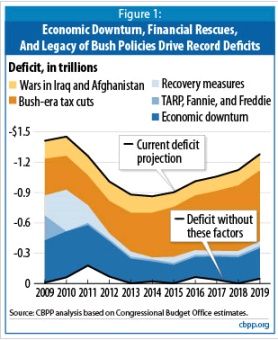
The graph to the right is from the Center for Budget Policy and Priorities. It shows the relative contribution of various factors to the deficit. It's not a full exposition, but take it for what it's worth. If we stopped the wars, restored the Bush tax cuts on the wealthiest citizens, and ended TARP, we would make a huge contribution to reducing the current deficit.

So why hasn't that happened? Congress and the White House would rather kill people overseas, reward Wall Street failures, and coddle the wealthiest citizens than reducethe deficit.

The solutions aren't that hard. Will they take action? Of course not.

Why do those in charge hate the citizens of this country? It's a fair assumption to say that they do hate us when they avoid obvious and direct solutions to a major problem. Instead, they've put together a stacked entitlement commission to tombstone Social Security. By their actions, their program is clear. "The middle class is being systematically wiped out" by the current leaders.

They ALL know this. Most of them do absolutely nothing.

All but a very few should be fired in 2010, without regard to party. If the next crew does the same, fire them too.

Addition: Have all federal candidates sign a contract - strictly enforced A Contract with the Citizens. Stiff penalties,like walking the plank if they deviate.


...and here is an insightful commenter's answer to the question, "Why do our elected leaders hate the citizens?":

"Why do elected leaders hate the citizens?"

I used to agonise night and day over the relentless hollowing out of American ideals, jurisprudence and governance. It really pained and depressed me to witness it by the decade, to live through it year upon year, helpless to turn us from war and ruin to peace and prosperity. To see where America is headed in its blind and fearful groping for wealth and power and safety and to also know there is no steering or stopping this thing, that it runs on gravity -- cost me so much time wasted on organizing and protesting, working Party politics, reading and studying, writing and marching, crying and thinking and talking . . . if I'd put all that effort into permaculture gardening it would have done far more actual good here on Earth, under the sun and sky.

But I marched and protested and petitioned and voted and agonised over America's penchant for endless war until I couldn't do it any more, because I became numb. Literally wordless. Nothing more to write or say to anyone. Not when all the words in the world can't steer this thing. It is not in our hands, the steering wheel.

In the face of all passion, logic, ideals, humanity -- the American war machine rolls on, right over real lives, right over human beings, in this country and Over There in Eastasia. And Oceania. The whole world is divided into theaters of American warfare. It is the perennial business of America to make war, to make "the world safe for United Fruit Company." (Smedley Butler)

I once heard tell of a Beatnik out in California, in the early Fifties, who plunked down court fees and changed his name to Neil Ism. I laughed at the time, but one morning a couple years ago realized that I knew this man very well, without ever meeting him. And that he was years ahead of me. One fine morning he chose gardening, period.

For it has gradually dawned on me that America IS just a machine, and this has taken the sting out of losing my love, my country. She's not a shining goal or ideal to me anymore; she's not a vision of loveliness. She's a thing with wheels and treads, something you get out of the way of. Or don't.

There is actually no human being or group of human beings in definitive charge, no group of people with a philosophy of Gotterdammerung in mind. As far as human beings go, there is just the pursuit of happiness, to use Jefferson's fine euphemism for human beings seeking wealth, safety, freedom from wants, and power. Nope, the human beings running organizations, institutions, governments and corporations are not starkly different from John and Jane Q. Publick. One pant leg at a time, and all that.

Sure, there are lots more functioning sociopaths and psychopaths in the upper ranks of all large organizations, but their goals and actions are tempered by all the more balanced people within the organization. In a fully pathological organization you would routinely use flamethrowers and artillery on a daily basis against your competitors, even if they only represented a 1% chance of ever challenging you. It would be the logical thing to do, in the simple pursuit of self interest.

Very few modern organizations actually exercise this approach.

No, it isn't the people, putting their pants on in the morning in order to pursue happiness all day, that steer America.

It is the organizations themselves, viewed as persons, that are utterly ruthless, soul-less psychopaths. And they have come to steer America. The human beings, in their pants, are just along for the ride.

Corporations that are organized for profit -- in particular -- are quite insane in this regard. It is not a matter of them following the law -- the law says they are created to seek profit for their own 'self' and shareholders only, and can consider nothing else. Nor is it a matter of writing laws to restrain or regulate them -- they write the laws of the land now, and always have -- because wealth is influence is power.

The wealthiest 5000 families in America also belong in this category, for their lives entire are at the service of their great wealth. And, their wealth is entirely invested within huge, psychopathic corporations. There is no difference in the machinery.

Our original Constitution was heavily influenced to favor wealthy white men -- landowners, slaveholders and bankers -- over the working man, or any woman, slave, or native. These wealthy white men were the feudal lords of the day, their godly superiority over others and their right to write the laws based entirely on the fact and influence of their many possessions. The Constitution and all established law reflected their views before other views. It is so in almost every nation today. Wealth is influence is power, and the grip of wealth upon government only gets tighter over time, like a python's does.

Corporations, especially when legally considered to possess every right and trait of living human beings, are our current feudal lords, our Really Large Citizens. America's laws and government(s) not only favors them, it IS them, for they finance the electees, and the elections, and they write the laws for the electees to vote upon -- very often without reading or understanding them. In State legislatures and in Congress, voting is by Party, and Party answers to electoral power, which answers to funding, which comes from corporations, who have agendas to be put into legal standing.

Agendas that aim to increase their grip on government, and their freedom to operate unregulated, unchallengeable, untouchable, too big to fail. There comes a point when government becomes a nuisance.

Power increases itself, just as wealth increases itself. Right now, the corporations of America hold more power than they ever have before, more than they ever dreamed would be theirs, more than they know quite what to do with. They are drunk with it, and yet want more. There comes a point when government becomes a real nuisance.

It is these 'corporate persons' our government looks out and sees, standing tall between our shining seas. The government sees and serves these Really Large Citizens. As for you and me, ehhh, not so much.

We actual human persons out here, in our pants, are seen as cattle, mere fodder units (as the Bush Family calls us), put here by God or Happenstance to serve as laborers and consumers and debtors for the corporations -- and damn sure for nothing more. If we were algae or germs we would receive the same consideration as homo sapiens sapiens do in America today. We have a role to play in the affairs of the nation -- laborers, consumers and debtors -- and have been granted the latitude to either fit in or be smooshed, no more. And it just gets tighter this way.

Even the so-called voting of we humans is so pre-arranged between corporate-friendly candidates as to be mere kabuki -- we can vote Red Party or Blue Party and no more real choice is offered. Votes aren't even counted any more, just pretend-counted in the digital depths of black boxes no one can ever look into since they belong to a registered corporation which has the inalienable right to privacy. If there were more votes cast than there are people registered to vote there is no recount, and no recourse -- even in the courts.

"Why do elected leaders hate the citizens?"

Your very question is wrong, sir. An unfortunate misperception on your part.

Our elected leaders do not hate the citizens. No no. Dear God, how they love them! They cater to their every whim, they roll in the hay with them at all hours, they take them in and take them on by the half dozen like legendary Shakespearean whores -- as long as those citizens are corporate persons in good wealth well then it's "Roll Me Over And Do It Again!" Leave some money on the dresser.

Corporations are the America's citizens. Human beings are cattle. Your mistake is mistaking human beings for citizens.

OMG that is sooooo 18th Century!

Antifa July 16, 2010 - 5:04pm

Labels: , , , ,

Sunday, February 24, 2008

Chalmers Johnson explains the situation

TomDipatch.com via Commondreams.com:

Why the Debt Crisis Is Now the Greatest Threat to the American Republic

by Chalmers Johnson

The military adventurers of the Bush administration have much in common with the corporate leaders of the defunct energy company Enron. Both groups of men thought that they were the “smartest guys in the room,” the title of Alex Gibney’s prize-winning film on what went wrong at Enron. The neoconservatives in the White House and the Pentagon outsmarted themselves. They failed even to address the problem of how to finance their schemes of imperialist wars and global domination.

As a result, going into 2008, the United States finds itself in the anomalous position of being unable to pay for its own elevated living standards or its wasteful, overly large military establishment. Its government no longer even attempts to reduce the ruinous expenses of maintaining huge standing armies, replacing the equipment that seven years of wars have destroyed or worn out, or preparing for a war in outer space against unknown adversaries. Instead, the Bush administration puts off these costs for future generations to pay — or repudiate. This utter fiscal irresponsibility has been disguised through many manipulative financial schemes (such as causing poorer countries to lend us unprecedented sums of money), but the time of reckoning is fast approaching.

There are three broad aspects to our debt crisis. First, in the current fiscal year (2008) we are spending insane amounts of money on “defense” projects that bear no relationship to the national security of the United States. Simultaneously, we are keeping the income tax burdens on the richest segments of the American population at strikingly low levels.

Second, we continue to believe that we can compensate for the accelerating erosion of our manufacturing base and our loss of jobs to foreign countries through massive military expenditures — so-called “military Keynesianism,” which I discuss in detail in my book Nemesis: The Last Days of the American Republic. By military Keynesianism, I mean the mistaken belief that public policies focused on frequent wars, huge expenditures on weapons and munitions, and large standing armies can indefinitely sustain a wealthy capitalist economy. The opposite is actually true.

Third, in our devotion to militarism (despite our limited resources), we are failing to invest in our social infrastructure and other requirements for the long-term health of our country. These are what economists call “opportunity costs,” things not done because we spent our money on something else. Our public education system has deteriorated alarmingly. We have failed to provide health care to all our citizens and neglected our responsibilities as the world’s number one polluter. Most important, we have lost our competitiveness as a manufacturer for civilian needs — an infinitely more efficient use of scarce resources than arms manufacturing. Let me discuss each of these.

And he does.

A more telling comparison that reveals just how much worse we’re doing can be found among the “current accounts” of various nations. The current account measures the net trade surplus or deficit of a country plus cross-border payments of interest, royalties, dividends, capital gains, foreign aid, and other income. For example, in order for Japan to manufacture anything, it must import all required raw materials. Even after this incredible expense is met, it still has an $88 billion per year trade surplus with the United States and enjoys the world’s second highest current account balance. (China is number one.) The United States, by contrast, is number 163 — dead last on the list, worse than countries like Australia and the United Kingdom that also have large trade deficits. Its 2006 current account deficit was $811.5 billion; second worst was Spain at $106.4 billion. This is what is unsustainable.
[. . .]

By 1990, the value of the weapons, equipment, and factories devoted to the Department of Defense was 83% of the value of all plants and equipment in American manufacturing. From 1947 to 1990, the combined U.S. military budgets amounted to $8.7 trillion. Even though the Soviet Union no longer exists, U.S. reliance on military Keynesianism has, if anything, ratcheted up, thanks to the massive vested interests that have become entrenched around the military establishment. Over time, a commitment to both guns and butter has proven an unstable configuration. Military industries crowd out the civilian economy and lead to severe economic weaknesses. Devotion to military Keynesianism is, in fact, a form of slow economic suicide.

On May 1, 2007, the Center for Economic and Policy Research of Washington, D.C., released a study prepared by the global forecasting company Global Insight on the long-term economic impact of increased military spending. Guided by economist Dean Baker, this research showed that, after an initial demand stimulus, by about the sixth year the effect of increased military spending turns negative. Needless to say, the U.S. economy has had to cope with growing defense spending for more than 60 years. He found that, after 10 years of higher defense spending, there would be 464,000 fewer jobs than in a baseline scenario that involved lower defense spending.

Baker concluded:

“It is often believed that wars and military spending increases are good for the economy. In fact, most economic models show that military spending diverts resources from productive uses, such as consumption and investment, and ultimately slows economic growth and reduces employment.”


[. . .]

Nuclear weapons furnish a striking illustration of these anomalies. Between the 1940s and 1996, the United States spent at least $5.8 trillion on the development, testing, and construction of nuclear bombs. By 1967, the peak year of its nuclear stockpile, the United States possessed some 32,500 deliverable atomic and hydrogen bombs, none of which, thankfully, was ever used. They perfectly illustrate the Keynesian principle that the government can provide make-work jobs to keep people employed. Nuclear weapons were not just America’s secret weapon, but also its secret economic weapon. As of 2006, we still had 9,960 of them. There is today no sane use for them, while the trillions spent on them could have been used to solve the problems of social security and health care, quality education and access to higher education for all, not to speak of the retention of highly skilled jobs within the American economy.

The pioneer in analyzing what has been lost as a result of military Keynesianism was the late Seymour Melman (1917-2004), a professor of industrial engineering and operations research at Columbia University. His 1970 book, Pentagon Capitalism: The Political Economy of War, was a prescient analysis of the unintended consequences of the American preoccupation with its armed forces and their weaponry since the onset of the Cold War. Melman wrote (pp. 2-3):

“From 1946 to 1969, the United States government spent over $1,000 billion on the military, more than half of this under the Kennedy and Johnson administrations — the period during which the [Pentagon-dominated] state management was established as a formal institution. This sum of staggering size (try to visualize a billion of something) does not express the cost of the military establishment to the nation as a whole. The true cost is measured by what has been foregone, by the accumulated deterioration in many facets of life by the inability to alleviate human wretchedness of long duration.”

In an important exegesis on Melman’s relevance to the current American economic situation, Thomas Woods writes:

“According to the U.S. Department of Defense, during the four decades from 1947 through 1987 it used (in 1982 dollars) $7.62 trillion in capital resources. In 1985, the Department of Commerce estimated the value of the nation’s plant and equipment, and infrastructure, at just over $7.29 trillion. In other words, the amount spent over that period could have doubled the American capital stock or modernized and replaced its existing stock.”

The fact that we did not modernize or replace our capital assets is one of the main reasons why, by the turn of the twenty-first century, our manufacturing base had all but evaporated. Machine tools — an industry on which Melman was an authority — are a particularly important symptom. In November 1968, a five-year inventory disclosed (p. 186) “that 64 percent of the metalworking machine tools used in U.S. industry were ten years old or older. The age of this industrial equipment (drills, lathes, etc.) marks the United States’ machine tool stock as the oldest among all major industrial nations, and it marks the continuation of a deterioration process that began with the end of the Second World War. This deterioration at the base of the industrial system certifies to the continuous debilitating and depleting effect that the military use of capital and research and development talent has had on American industry.”

Nothing has been done in the period since 1968 to reverse these trends and it shows today in our massive imports of equipment — from medical machines like proton accelerators for radiological therapy (made primarily in Belgium, Germany, and Japan) to cars and trucks.

Our short tenure as the world’s “lone superpower” has come to an end. As Harvard economics professor Benjamin Friedman has written:

“Again and again it has always been the world’s leading lending country that has been the premier country in terms of political influence, diplomatic influence, and cultural influence. It’s no accident that we took over the role from the British at the same time that we took over… the job of being the world’s leading lending country. Today we are no longer the world’s leading lending country. In fact we are now the world’s biggest debtor country, and we are continuing to wield influence on the basis of military prowess alone.”

Some of the damage done can never be rectified. There are, however, some steps that this country urgently needs to take. These include reversing Bush’s 2001 and 2003 tax cuts for the wealthy, beginning to liquidate our global empire of over 800 military bases, cutting from the defense budget all projects that bear no relationship to the national security of the United States, and ceasing to use the defense budget as a Keynesian jobs program. If we do these things we have a chance of squeaking by. If we don’t, we face probable national insolvency and a long depression.

Chalmers Johnson is the author of Nemesis: The Last Days of the American Republic, just published in paperback. It is the final volume of his Blowback Trilogy, which also includes Blowback (2000) and The Sorrows of Empire (2004).

[Note: For those interested, click here to view a clip from a new film, “Chalmers Johnson on American Hegemony,” in Cinema Libre Studios’ Speaking Freely series in which he discusses “military Keynesianism” and imperial bankruptcy. For sources on global military spending, please see: (1) Global Security Organization, “World Wide Military Expenditures” as well as Glenn Greenwald, “The bipartisan consensus on U.S. military spending”; (2) Stockholm International Peace Research Institute, “Report: China biggest Asian military spender.”]

Labels: , , , , ,

Web Site Counters
Staples Coupons