Monday, July 19, 2010

I remember when the Republican fundraisers were the crooks...!

the money quote, so to speak:

"Nemazee had been the national finance chairman of Clinton's 2008 presidential campaign."

AP:
Ex-Clinton fundraiser gets 12 years in prison

NEW YORK — A wealthy Manhattan investment banker who was once a top fundraiser for Hillary Rodham Clinton and other big-name Democrats has been sentenced to 12 years in prison for bank fraud.

Hassan Nemazee (hah-SAHN' nah-MAH'-zee) was sentenced Thursday in federal court in Manhattan.

He had reached a plea deal in March. He has admitted to three counts of bank fraud and one count of wire fraud.

Prosecutors say he forged signatures and concocted bogus account statements to conceal a scam in which he was using proceeds from new loans to pay off older ones.

Nemazee had been the national finance chairman of Clinton's 2008 presidential campaign. He also raised money for President Barack Obama and other prominent Democrats.

Labels: , ,

Sunday, March 09, 2008

Hillary's unpardonable sin

(I had no idea this would get as many hits as it has. I should credit Jonathan Schwarz in his A Tiny Revolution blog for inspiring me to tackle this.)

It's my understanding that the only unpardonable sin is the one that a person does not recognize as a sin.

This is the full text of Hillary's vote for the resolution giving W the power he's abused ever since in red, with certain parts made into boldface by me, and my comments in black:

October 10, 2002
Floor Speech of Senator Hillary Rodham Clinton
on S.J. Res. 45, A Resolution to Authorize the Use of
United States Armed Forces Against Iraq

As Delivered

Today we are asked whether to give the President of the United States authority to use force in Iraq should diplomatic efforts fail to dismantle Saddam Hussein's chemical and biological weapons and his nuclear program.

Right off the bat, we are told assumptions as if they are undisputed facts. They were not.

I am honored to represent nearly 19 million New Yorkers, a thoughtful democracy of voices and opinions who make themselves heard on the great issues of our day especially this one. Many have contacted my office about this resolution, both in support of and in opposition to it, and I am grateful to all who have expressed an opinion.

I also greatly respect the differing opinions within this body. The debate they engender will aid our search for a wise, effective policy. Therefore, on no account should dissent be discouraged or disparaged. It is central to our freedom and to our progress, for on more than one occasion, history has proven our great dissenters to be right.

Now, I believe the facts that have brought us to this fateful vote are not in doubt. Saddam Hussein is a tyrant who has tortured and killed his own people, even his own family members, to maintain his iron grip on power. He used chemical weapons on Iraqi Kurds and on Iranians, killing over 20 thousand people. Unfortunately, during the 1980's, while he engaged in such horrific activity, he enjoyed the support of the American government, because he had oil and was seen as a counterweight to the Ayatollah Khomeini in Iran.

In 1991, Saddam Hussein invaded and occupied Kuwait, losing the support of the United States. The first President Bush assembled a global coalition, including many Arab states, and threw Saddam out after forty-three days of bombing and a hundred hours of ground operations. The U.S.-led coalition then withdrew, leaving the Kurds and the Shiites, who had risen against Saddam Hussein at our urging, to Saddam's revenge.

As a condition for ending the conflict, the United Nations imposed a number of requirements on Iraq, among them disarmament of all weapons of mass destruction, stocks used to make such weapons, and laboratories necessary to do the work. Saddam Hussein agreed, and an inspection system was set up to ensure compliance. And though he repeatedly lied, delayed, and obstructed the inspections work, the inspectors found and destroyed far more weapons of mass destruction capability than were destroyed in the Gulf War, including thousands of chemical weapons, large volumes of chemical and biological stocks, a number of missiles and warheads, a major lab equipped to produce anthrax and other bio-weapons, as well as substantial nuclear facilities.

In 1998, Saddam Hussein pressured the United Nations to lift the sanctions by threatening to stop all cooperation with the inspectors. In an attempt to resolve the situation, the UN, unwisely in my view, agreed to put limits on inspections of designated "sovereign sites" including the so-called presidential palaces, which in reality were huge compounds well suited to hold weapons labs, stocks, and records which Saddam Hussein was required by UN resolution to turn over. When Saddam blocked the inspection process, the inspectors left. As a result, President Clinton, with the British and others, ordered an intensive four-day air assault, Operation Desert Fox, on known and suspected weapons of mass destruction sites and other military targets.

This is a lie, albeit one perpetrated by BushCo. and backed up by most of US media. Look it up:
The Washington Post reported all these facts correctly at the time: A December 18 article by national security correspondent Barton Gellman reported that "Butler ordered his inspectors to evacuate Baghdad, in anticipation of a military attack, on Tuesday night."

But in the 14 months since then, the Washington Post has again and again tried to rewrite history--claiming that Saddam Hussein expelled the U.N. inspectors from Iraq. Despite repeated attempts by its readers to set the record straight in letters to the editor, the Post has persisted in reporting this fiction.

Not only did Saddam Hussein not order the inspectors' retreat, but Butler's decision to withdraw them was--to say the least--highly controversial. The Washington Post (12/17/98) reported that as Butler was drafting his report on Iraqi cooperation, U.S. officials were secretly consulting with him about how to frame his conclusions.

According to the Post, a New York diplomat "generally sympathetic toWashington" argued--along with French, Russian, Chinese, and U.N.officials--that Butler, working in collusion with the U.S., "deliberately wrote a justification for war." "Based on the same facts," the diplomat said, "he [Butler] could have just said, 'There were something like 300 inspections and we encountered difficulties in five.'"
The inspectors were not withdrawn because of anything Saddam did. Inspectors were withdrawn because Bill Clinton was proceeding with his bombing campaign. It is instructive to look back at the reasons given by Bill Clinton for Operation Desert Fox in the first place, and what the international reaction to it was.

In 1998, the United States also changed its underlying policy toward Iraq from containment to regime change and began to examine options to effect such a change, including support for Iraqi opposition leaders within the country and abroad.

In the four years since the inspectors left, intelligence reports show that Saddam Hussein has worked to rebuild his chemical and biological weapons stock, his missile delivery capability, and his nuclear program. He has also given aid, comfort, and sanctuary to terrorists, including Al Qaeda members, though there is apparently no evidence of his involvement in the terrible events of September 11, 2001.

It is clear, however, that if left unchecked, Saddam Hussein will continue to increase his capacity to wage biological and chemical warfare, and will keep trying to develop nuclear weapons. Should he succeed in that endeavor, he could alter the political and security landscape of the Middle East, which as we know all too well affects American security.

Now this much is undisputed. The open questions are: what should we do about it? How, when, and with whom?

This was ABSOLUTELY DISPUTED, by hundreds of thousands of people across the country, in streets and cities and marches everywhere. I was in some of them. I have reams of columns and letters from people experienced in intelligence who disputed every bit of this. She was either ignorant or lying. Either should disqualify her from being president.

Back to Hillary:

Some people favor attacking Saddam Hussein now, with any allies we can muster, in the belief that one more round of weapons inspections would not produce the required disarmament, and that deposing Saddam would be a positive good for the Iraqi people and would create the possibility of a secular democratic state in the Middle East, one which could perhaps move the entire region toward democratic reform.

This view has appeal to some, because it would assure disarmament; because it would right old wrongs after our abandonment of the Shiites and Kurds in 1991, and our support for Saddam Hussein in the 1980's when he was using chemical weapons and terrorizing his people; and because it would give the Iraqi people a chance to build a future in freedom.

However, this course is fraught with danger. We and our NATO allies did not depose Mr. Milosevic, who was responsible for more than a quarter of a million people being killed in the 1990s. Instead, by stopping his aggression in Bosnia and Kosovo, and keeping on the tough sanctions, we created the conditions in which his own people threw him out and led to his being in the dock being tried for war crimes as we speak.

If we were to attack Iraq now, alone or with few allies, it would set a precedent that could come back to haunt us. In recent days, Russia has talked of an invasion of Georgia to attack Chechen rebels. India has mentioned the possibility of a pre-emptive strike on Pakistan. And what if China were to perceive a threat from Taiwan?

So Mr. President, for all its appeal, a unilateral attack, while it cannot be ruled out, on the present facts is not a good option.

Others argue that we should work through the United Nations and should only resort to force if and when the United Nations Security Council approves it. This too has great appeal for different reasons. The UN deserves our support. Whenever possible we should work through it and strengthen it, for it enables the world to share the risks and burdens of global security and when it acts, it confers a legitimacy that increases the likelihood of long-term success. The UN can help lead the world into a new era of global cooperation and the United States should support that goal.

But there are problems with this approach as well. The United Nations is an organization that is still growing and maturing. It often lacks the cohesion to enforce its own mandates. And when Security Council members use the veto, on occasion, for reasons of narrow-minded interests, it cannot act. In Kosovo, the Russians did not approve NATO military action because of political, ethnic, and religious ties to the Serbs. The United States therefore could not obtain a Security Council resolution in favor of the action necessary to stop the dislocation and ethnic cleansing of more than a million Kosovar Albanians. However, most of the world was with us because there was a genuine emergency with thousands dead and a million driven from their homes. As soon as the American-led conflict was over, Russia joined the peacekeeping effort that is still underway.

In the case of Iraq, recent comments indicate that one or two Security Council members might never approve force against Saddam Hussein until he has actually used chemical, biological, or God forbid, nuclear weapons.

So, Mr. President, the question is how do we do our best to both defuse the real threat that Saddam Hussein poses to his people, to the region, including Israel, to the United States, to the world, and at the same time, work to maximize our international support and strengthen the United Nations?

As Reagan would say, "There she goes again!"
Saddam posed no real threat to the region, the United States, or the World. Look at what the intelligence agencies were saying at the time. Hillary is repeating the con perpetrated by Bush and his lackeys, which closely parallels what her husband was saying when he launched a bombing campaign on the eve of the Monica hearings.


While there is no perfect approach to this thorny dilemma, and while people of good faith and high intelligence can reach diametrically opposed conclusions, I believe the best course is to go to the UN for a strong resolution that scraps the 1998 restrictions on inspections and calls for complete, unlimited inspections with cooperation expected and demanded from Iraq. I know that the Administration wants more, including an explicit authorization to use force, but we may not be able to secure that now, perhaps even later. But if we get a clear requirement for unfettered inspections, I believe the authority to use force to enforce that mandate is inherent in the original 1991 UN resolution, as President Clinton recognized when he launched Operation Desert Fox in 1998.

Ah, what is this? Hillary admitting in certain circumstances this resolution will give Bush the very authority to use force which she claims to not be giving him? And which she to this day claims not to have given him? She's saying that since Bill claimed authority to act illegally, so should Bush.

If we get the resolution that President Bush seeks, and if Saddam complies, disarmament can proceed and the threat can be eliminated. Regime change will, of course, take longer but we must still work for it, nurturing all reasonable forces of opposition.

If we get the resolution and Saddam does not comply, then we can attack him with far more support and legitimacy than we would have otherwise.

If we try and fail to get a resolution that simply, but forcefully, calls for Saddam's compliance with unlimited inspections, those who oppose even that will be in an indefensible position. And, we will still have more support and legitimacy than if we insist now on a resolution that includes authorizing military action and other requirements giving some nations superficially legitimate reasons to oppose any Security Council action. They will say we never wanted a resolution at all and that we only support the United Nations when it does exactly what we want.

I believe international support and legitimacy are crucial. After shots are fired and bombs are dropped, not all consequences are predictable. While the military outcome is not in doubt, should we put troops on the ground, there is still the matter of Saddam Hussein's biological and chemical weapons. Today he has maximum incentive not to use them or give them away. If he did either, the world would demand his immediate removal. Once the battle is joined, however, with the outcome certain, he will have maximum incentive to use weapons of mass destruction and to give what he can't use to terrorists who can torment us with them long after he is gone. We cannot be paralyzed by this possibility, but we would be foolish to ignore it. And according to recent reports, the CIA agrees with this analysis. A world united in sharing the risk at least would make this occurrence less likely and more bearable and would be far more likely to share with us the considerable burden of rebuilding a secure and peaceful post-Saddam Iraq.

President Bush's speech in Cincinnati and the changes in policy that have come forth since the Administration began broaching this issue some weeks ago have made my vote easier. Even though the resolution before the Senate is not as strong as I would like in requiring the diplomatic route first and placing highest priority on a simple, clear requirement for unlimited inspections, I will take the President at his word that he will try hard to pass a UN resolution and will seek to avoid war, if at all possible.

This is more damning in another way. Not one person I know who reads legitimate news would have trusted Bush to do anything of this importance. Look at his track record at the time. She has the lack of discernment to actually "take the President at his word." That is as disqualifying a statement as any I've ever heard a presdential candidate make.

Because bipartisan support for this resolution makes success in the United Nations more likely, and therefore, war less likely, and because a good faith effort by the United States, even if it fails, will bring more allies and legitimacy to our cause, I have concluded, after careful and serious consideration, that a vote for the resolution best serves the security of our nation. If we were to defeat this resolution or pass it with only a few Democrats, I am concerned that those who want to pretend this problem will go way with delay will oppose any UN resolution calling for unrestricted inspections.

This is a very difficult vote. This is probably the hardest decision I have ever had to make -- any vote that may lead to war should be hard -- but I cast it with conviction.

And perhaps my decision is influenced by my eight years of experience on the other end of Pennsylvania Avenue in the White House watching my husband deal with serious challenges to our nation. I want this President, or any future President, to be in the strongest possible position to lead our country in the United Nations or in war. Secondly, I want to insure that Saddam Hussein makes no mistake about our national unity and for our support for the President's efforts to wage America's war against terrorists and weapons of mass destruction. And thirdly, I want the men and women in our Armed Forces to know that if they should be called upon to act against Iraq, our country will stand resolutely behind them.

My vote is not, however, a vote for any new doctrine of pre-emption, or for uni-lateralism, or for the arrogance of American power or purpose -- all of which carry grave dangers for our nation, for the rule of international law and for the peace and security of people throughout the world.

but Hillary, a few paragraphs ago you said:
But if we get a clear requirement for unfettered inspections, I believe the authority to use force to enforce that mandate is inherent in the original 1991 UN resolution, as President Clinton recognized when he launched Operation Desert Fox in 1998.
If Bill could do it, George can do it, with your blessings, apparently.

Over eleven years have passed since the UN called on Saddam Hussein to rid himself of weapons of mass destruction as a condition of returning to the world community. Time and time again he has frustrated and denied these conditions. This matter cannot be left hanging forever with consequences we would all live to regret.

As the inspectors knew then, and as anyone listening to them knew then, Saddam complied with these conditions. Remember the thouands of pages of documents he delivered to the UN, and how the US removed a huge pile of them? Again, Hillary is buying into and repeating Bush's lies.
War can yet be avoided, but our responsibility to global security and to the integrity of United Nations resolutions protecting it cannot. I urge the President to spare no effort to secure a clear, unambiguous demand by the United Nations for unlimited inspections.

It would be instructive if politicians would spend as much time trying to enforce the other parts of United Nations resolutions, like the parts calling for a nuclear free middle east...

And finally, on another personal note, I come to this decision from the perspective of a Senator from New York who has seen all too closely the consequences of last year's terrible attacks on our nation. In balancing the risks of action versus inaction, I think New Yorkers who have gone through the fires of hell may be more attuned to the risk of not acting. I know that I am.
Do I hear premonitions of Rudy yelling "911! 911!"?
So it is with conviction that I support this resolution as being in the best interests of our nation. A vote for it is not a vote to rush to war; it is a vote that puts awesome responsibility in the hands of our President and we say to him - use these powers wisely and as a last resort. And it is a vote that says clearly to Saddam Hussein - this is your last chance - disarm or be disarmed.

Thank you, Mr. President.
And now millions are considering putting that same awesome responsibility in her hands.


Labels: , , , ,

Wednesday, February 27, 2008

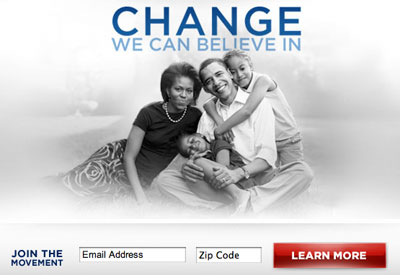
What would you rather be asked to do by a candidate? "Learn More"... or "Submit"?

Bob Harris:

Tuesday, 26 February 2008
This is absolutely no big deal. But sometimes little details can be telling. And there's a tiny but obvious difference between the front pages of the Obama and Clinton websites that seems almost emblematic of how the campaigns are increasingly perceived.

What makes you feel more respected, really -- being asked to "Learn More"...

Sample Image

... or to "Submit"?

Sample Image

Just saying.

Labels: , ,

Thursday, January 31, 2008

What is an "issue"?

George Lakoff explains the difference between the Clintons' idea of "issues" and Obama's.


Huffingtonpost.com:

Political endorsements rarely make interesting reading. But this year is different. Take the endorsements of Hillary Clinton by the New York Times [NY Times, January 25, 2008] and Barack Obama by Caroline Kennedy [NY Times, January 27, 2008].

To the editors of the New York Times, Hillary Clinton and Barack Obama agree on policy goals:

"On the major issues, there is no real gulf separating the two. They promise an end to the war in Iraq, more equitable taxation, more effective government spending, more concern for social issues, a restoration of civil liberties and an end to the politics of division of George W. Bush and Karl Rove."

What matters to the editors is experience in "tackling ... issues" -- in mastering details of policy and carrying them out one by one. "The next president needs to start immediately on challenges that will require concrete solutions, resolve, and the ability to make government work."

To Caroline Kennedy, policy is not the real issue:

"Most of us would prefer to base our voting decision on policy differences. However, the candidates' goals are similar. They have all laid out detailed plans on everything from strengthening our middle class to investing in early childhood education. So qualities of leadership, character and judgment play a larger role than usual.

"I want a president who understands that his responsibility is to articulate a vision and encourage others to achieve it; who holds himself, and those around him, to the highest ethical standards; who appeals to the hopes of those who still believe in the American Dream, and those around the world who still believe in the American ideal; and who can lift our spirits, and make us believe again that our country needs every one of us to get involved."

The difference is striking. To the editors of the New York Times, the quality of leadership seems not to be an "issue." The ability to unite the country is not an "issue." What Obama calls the empathy deficit -- attunement to the experience and needs of real people -- is not an "issue." Honesty is not an "issue." Trust is not an "issue." Moral judgment is not an "issue." Values are not "issues." Adherence to democratic ideals -- rather than political positioning, triangulation, and incrementalism -- are not "issues." Inspiration, a call to a higher purpose, and a transcendence of interest-based politics are not "issues."

It is time to understand what counts as an "issue," to whom, and why.

In Thinking Points, the handbook for progressives that the Rockridge Institute staff and I wrote last year, we began by analyzing Ronald Reagan's strengths as a politician. According to his chief strategist, Richard Wirthlin, Reagan realized that most voters do not vote primarily on the basis of policies, but rather on (1) values, (2) connection, (3) authenticity, (4) trust, and (5) identity. That is, Reagan spoke about his values, and policies for him just exemplified values. He connected viscerally with people. He was perceived as authentic, as really believing what he said. As a result, people trusted him and identified with him. Even if they had different positions on issues, they knew where he stood. Even when his economic policies did not produce a "Morning in America," voters still felt a connection to him because he spoke to what they wanted America to be. That was what allowed Reagan to gain the votes of so many independents and Democrats.

There is a reason that Obama recently spoke of Reagan. Reagan understood that you win elections by drawing support from independents and the opposite side. He understood what unified the country so that he could lead it according to his vision. His vision was a radical conservative one, a vision devastating for the country and contradicted by his economic policies.

Obama understands the importance of values, connection, authenticity, trust, and identity.

But his vision is deeply progressive. He proposes to lead in a very different direction than Reagan. Crucially, he adds to that vision a streetwise pragmatism: his policies have to do more than look good on paper; they have to bring concrete material results to millions of struggling Americans in the lower and middle classes. They have to meet the criteria of a community organizer.

The Clintonian policy wonks don't seem to understand any of this. They have trivialized Reagan's political acumen as an illegitimate triumph of personality over policy. They confuse values with programs. They have underestimated authenticity and trust.

So do the pundits who pose the questions in the debates.

This nomination campaign is about much more than the candidates. It about a major split within the Democratic party. The candidates are reflecting that split. Here are three of the major "issues" dividing Democrats.

First, triangulation: moving to the right -- adopting right-wing positions -- to get more votes. Bill Clinton did it and Hillary believes in it. It is what she means by "bipartisanship." Obama means the opposite by "bipartisanship." To Obama, it is a recognition that central progressive moral principles are fundamental American principles. For him, bipartisanship means finding people who call themselves "conservatives" or "independents," but who share those central American values with progressives. Obama thus doesn't have to surrender or dilute his principles for the sake of "bipartisanship."

The second is incrementalism: Hillary believes in getting lots of small carefully crafted policies through, one at a time, step by small step, real but almost unnoticed. Obama believes in bold moves and the building of a movement in which the bold moves are demanded by the people and celebrated when they happen. This is the reason why Hillary talks about "I," I," "I" (the crafter of the policy) and Obama talks about "you" and "we" (the people who demand it and who jointly carry it out).

The third is interest group politics: Hillary looks at politics through interests and interest groups, seeking policies that satisfy the interests of such groups. Obama's thinking emphasizes empathy over interest groups. He also sees empathy as central to the very idea of America. The result is a positive politics grounded in empathy and caring that is also patriotic and uplifting.

For a great many Democrats, these are the real issues. These real differences between the candidates reflect real differences within the party. Whoever gets the nomination, these differences will remain.

It is time for the press, the pundits, the pollsters, and the political scientists to take these issues seriously.

Labels: , , , , ,

Friday, November 16, 2007

The circular firing squad in action

A Tiny Revolution:

Here’s Hillary Clinton in the debate last night, responding to Obama’s proposal to raise the payroll cap for Social Security:

CLINTON: I do not want to fix the problems of Social Security on the backs of middle class families and seniors. If you lift the cap completely, that is a $1 trillion tax increase.

This is why my strategy is to hate all leaders, at all times, in all circumstances.

First, Obama uses right-wing talking points to tell us how we must be VERY VERY WORRIED about Social Security, so he can portray himself as a BOLD TRUTH TELLER.

Then, Clinton uses right-wing talking points to attack him for proposing a MASSIVE TAX INCREASE so she can portray herself as NOT A DIRTY TAX-RAISING LIBERAL.

In reality, there’s no reason to fret about Social Security or change it at all now. Obama is trying to scare us by thinking there is.

But if we have to change things in the future, the changes necessary would be minor. Clinton is trying to scare us by throwing around huge numbers most people don’t understand. The $1 trillion tax increase she’s talking about would be over 75 years, during which time the U.S. GDP is projected to be $600 trillion. It would also only affect the best-off people in America. (Moreover, Clinton’s numbers are wrong; eliminating the payroll cap would be more like a $4 trillion tax increase, depending on how you measure it. I suspect she lowballed it in order to make her fearmongering more credible.)

So hand in hand, Obama and Clinton each endorse one-half of the right-wing story, adding up to one gruesome whole. Here’s Sean Hannity, speaking to you during the recession of 2012:

HANNITY: How can you criticize Republican proposals to privatize Social Security, when even Barack Obama and Hillary Clinton agree we should be VERY VERY WORRIED and that the only alternative to privatization is a MASSIVE TAX INCREASE?

AND: This is yet another example of the Iron Law of Institutions.

(Thanks to Dean Baker for help with the specific numbers.)

posted by Jonathan Schwarz at 12:16 PM

Labels: , , , ,

Web Site Counters
Staples Coupons